Types of Firewalls Explained: Functions and Uses in Network Security
Explore the main types of firewalls, their functions, and how they help secure networks from unauthorized access and threats.

This article explains the types of firewalls, detailing their specific functions and how they apply to network security strategies.
Firewalls serve as critical barriers between trusted internal networks and potentially harmful external environments. Understanding the different types of firewalls—including packet-filtering, stateful inspection, and proxy firewalls—enables IT professionals and network administrators to select the most effective solution for their organization. Each type offers distinct capabilities, such as filtering traffic based on IP addresses, monitoring active connections, or inspecting application-level data. The choice depends on factors like network complexity, performance needs, and security policies.
By integrating the classification of firewalls with practical deployment scenarios, this guide helps decision-makers align firewall technology with their specific security requirements.
What are the types of firewalls
Firewalls serve as critical barriers that control incoming and outgoing network traffic based on predefined security rules. They form the first line of defense in a network security strategy by filtering data packets to prevent unauthorized access and threats.
Fundamentally, firewalls fall into three primary categories: packet-filtering, stateful inspection, and proxy firewalls. Each type offers distinct methods of monitoring and controlling network traffic.
| Firewall Type | Primary Function | Key Characteristics |
|---|---|---|
| Packet-Filtering Firewall | Inspects individual packets for source/destination IP addresses and ports | Fast processing, low resource use, but limited context awareness |
| Stateful Inspection Firewall | Tracks active connections and verifies packet legitimacy within those sessions | More secure than packet-filtering, moderate resource use, understands connection state |
| Proxy Firewall | Acts as an intermediary by inspecting and filtering traffic at the application layer | High security, inspects content deeply, can introduce latency |
For example, in a corporate environment, a stateful inspection firewall might be deployed at the network perimeter to allow legitimate user sessions while blocking suspicious attempts. Meanwhile, a proxy firewall could be used internally to filter web traffic, blocking access to harmful websites by analyzing the content of HTTP requests.
Tip: Understanding the trade-offs between speed, security depth, and resource demands will guide the choice of an appropriate firewall type for a given network environment.
What are the 3 types of firewalls
The three most commonly referenced firewall types are packet-filtering, stateful inspection, and proxy firewalls. Each operates differently, offering distinct security postures and deployment considerations.
Packet-filtering firewalls
Packet-filtering firewalls examine network packets based on predefined rules, such as source and destination IP addresses, ports, and protocols. For example, a rule might block incoming traffic on port 23 (Telnet) to prevent unauthorized access. This type is efficient and fast but lacks the ability to track connection states, making it vulnerable to certain attacks like IP spoofing.
Stateful inspection firewalls
Stateful inspection firewalls go beyond packet filtering by maintaining context about active connections. They track the state of network sessions, allowing them to accept only packets that are part of legitimate, established connections. For instance, after a client initiates a web session over HTTP, the firewall permits return traffic on the relevant port but blocks unsolicited attempts. This approach balances security and performance but requires more memory and processing power.
Proxy firewalls
Proxy firewalls act as intermediaries between users and the network, inspecting application-layer data before forwarding it. For example, a proxy firewall for HTTP can analyze web requests, filter harmful content, and enforce user policies. This deep inspection enhances security by preventing certain attacks and hiding internal network details but can introduce latency and complexity. They are well-suited for environments requiring granular control and content filtering.
Tip: Selecting a firewall type depends on specific network requirements; combining multiple types can provide layered defense.
What are the two types of firewalls
Hardware Firewalls
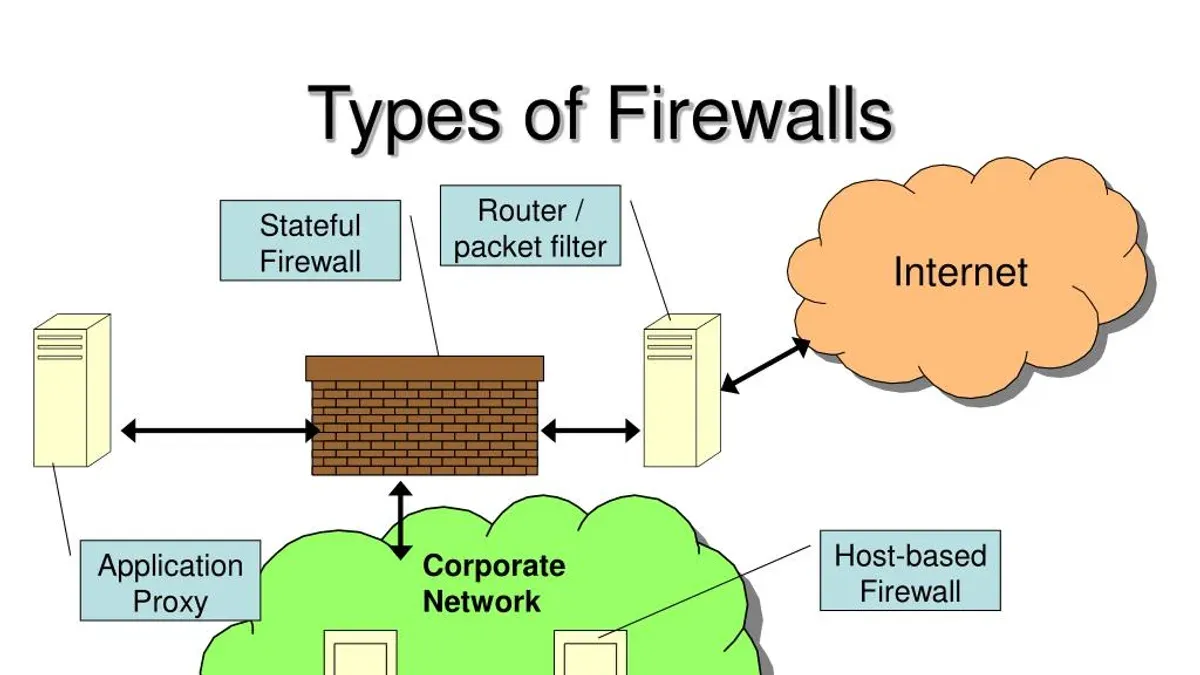
Hardware firewalls are physical devices placed between a network and external connections, typically deployed at the perimeter of an organization's infrastructure. These devices filter incoming and outgoing traffic before it reaches internal systems, providing a first line of defense. For example, a dedicated firewall appliance might be installed at a corporate office to manage traffic between the internet and the local area network (LAN), handling large volumes of data with minimal latency.
Software Firewalls
Software firewalls are applications installed on individual endpoints or servers, controlling network traffic to and from that specific device. They offer granular protection by monitoring applications and processes on the host machine, making them essential for endpoint security. For instance, a laptop used by a remote employee may run a software firewall to block unauthorized outbound connections or suspicious inbound traffic.
Combining hardware and software firewalls creates a layered security model, enhancing protection by addressing different attack vectors. Hardware firewalls manage broad network traffic, while software firewalls provide detailed control at the endpoint level. This approach is common in enterprise environments aiming to reduce vulnerabilities.
Tip: Deploying both types can improve overall security but requires careful configuration to avoid conflicts and ensure seamless traffic flow.
Why have a firewall
Firewalls serve as the essential first line of defense in cybersecurity by preventing unauthorized access to networks. They act as vigilant gatekeepers, monitoring incoming and outgoing traffic based on predetermined security rules. This continuous scrutiny helps organizations block malicious attempts such as hacking, malware infiltration, and data exfiltration before they can cause harm.
By controlling network traffic, firewalls not only protect sensitive data but also help maintain network performance and integrity. For example, a corporate network firewall can block traffic from suspicious IP addresses attempting to exploit vulnerabilities, thus stopping a potential breach early.
Beyond protection, firewalls contribute to regulatory compliance by enforcing security policies required by standards like PCI DSS, HIPAA, and GDPR. Organizations that deploy effective firewall solutions reduce their risk exposure and demonstrate due diligence in safeguarding customer and operational data.
A concrete example is a financial institution using a stateful inspection firewall to monitor session information for suspicious activity. When an attacker tries to manipulate session states to gain unauthorized access, the firewall identifies and blocks the anomaly, preventing a costly security incident.
Types of firewalls and their functions
Firewalls operate through distinct technical mechanisms to control network traffic and enforce security policies. Packet-filtering firewalls inspect headers of individual packets, checking source and destination IP addresses, ports, and protocols against predefined rules. For example, a firewall rule might permit inbound HTTP traffic on port 80 while blocking others, effectively filtering unauthorized access attempts.
Stateful inspection firewalls extend packet filtering by maintaining session states. They track the active connections and verify that incoming packets belong to a legitimate session. This functionality supports security goals such as integrity and availability by preventing spoofed packets and ensuring that only valid, established sessions transmit data.
Proxy firewalls act as intermediaries between users and external networks, performing deep content filtering and protocol validation. By terminating connections on behalf of clients, they can inspect application-layer data, blocking malicious payloads or unauthorized requests. For instance, a proxy firewall might scan outbound email traffic for sensitive data, enforcing confidentiality policies.
Firewall logs typically record decisions at each inspection stage. A typical log entry might show a packet from IP 192.168.1.10 to 203.0.113.5 on port 443 being allowed due to a matching rule, while another packet on port 23 is dropped due to a policy violation. This granular visibility aids in auditing and troubleshooting.
Each firewall type serves specific security needs: packet filtering ensures basic perimeter defense; stateful inspection enforces session validity; proxies provide thorough content scrutiny. Selecting the appropriate type depends on organizational priorities for confidentiality, integrity, and availability.
Types of firewalls in network security and cryptography
Firewalls play a pivotal role in securing encrypted network traffic, particularly within Virtual Private Networks (VPNs), where data confidentiality is maintained through cryptographic protocols like IPsec and SSL/TLS. Integrating firewall technologies with cryptographic methods allows organizations to enforce security policies even on encrypted streams, which is essential as encryption becomes the standard for protecting data in transit.
Inspecting encrypted traffic presents significant challenges because traditional firewalls cannot analyze content without decrypting it first. This requires the firewall to act as a termination point for encrypted sessions, often implemented through SSL/TLS interception, where the firewall decrypts, inspects, and then re-encrypts traffic. However, this process can introduce latency and requires careful certificate management to avoid trust issues on client devices.
Tip: When deploying SSL/TLS inspection, ensure firewall policies balance security needs with privacy concerns and performance impact.
Emerging firewall features increasingly incorporate cryptographic functions such as integrated cryptographic accelerators and support for post-quantum cryptography algorithms to future-proof encrypted traffic handling. Some next-generation firewalls combine deep packet inspection with cryptographic analysis to detect anomalies even within encrypted tunnels.
A practical example is a corporate environment where a next-generation firewall manages VPN connections from remote employees. The firewall decrypts incoming SSL VPN traffic, applies intrusion prevention rules, and re-encrypts data before forwarding it internally. This setup enables threat detection without compromising the confidentiality ensured by encryption. However, administrators must monitor processing overhead, as inspecting encrypted traffic typically requires more CPU resources than unencrypted traffic.
Common mistakes to avoid when choosing or deploying firewalls
One frequent error is relying solely on a single firewall type, such as only deploying a hardware firewall at the network perimeter without complementary software firewalls on endpoints. This layered defense approach is essential because attackers often exploit internal vulnerabilities after bypassing perimeter controls.
Misconfiguration remains a persistent issue. For example, leaving default settings unchanged—like open ports or overly permissive rules in firewall management consoles—can expose critical systems. A notable case involved a healthcare organization whose failure to restrict inbound traffic on port 3389 (Remote Desktop Protocol) allowed attackers to infiltrate the network, leading to data breaches.
Another common mistake is neglecting to tailor firewall rules to the specific network environment and traffic patterns. Generic rule sets may block legitimate applications or allow unnecessary services, reducing security effectiveness and operational efficiency. Regular audits and traffic analysis help in refining these rules based on actual usage.
Tip: Periodically review firewall configurations and update rulesets to reflect changes in network architecture and threat landscape.
Practical applications of different firewall types in various environments
Small businesses often prioritize simplicity and cost-effectiveness, favoring integrated hardware firewalls with built-in software capabilities. These devices, such as unified threat management (UTM) appliances, combine packet filtering and proxy functions, offering manageable security without complex configurations. For example, a local retail store might deploy a UTM device to protect its point-of-sale system and guest Wi-Fi, balancing security and ease of use.
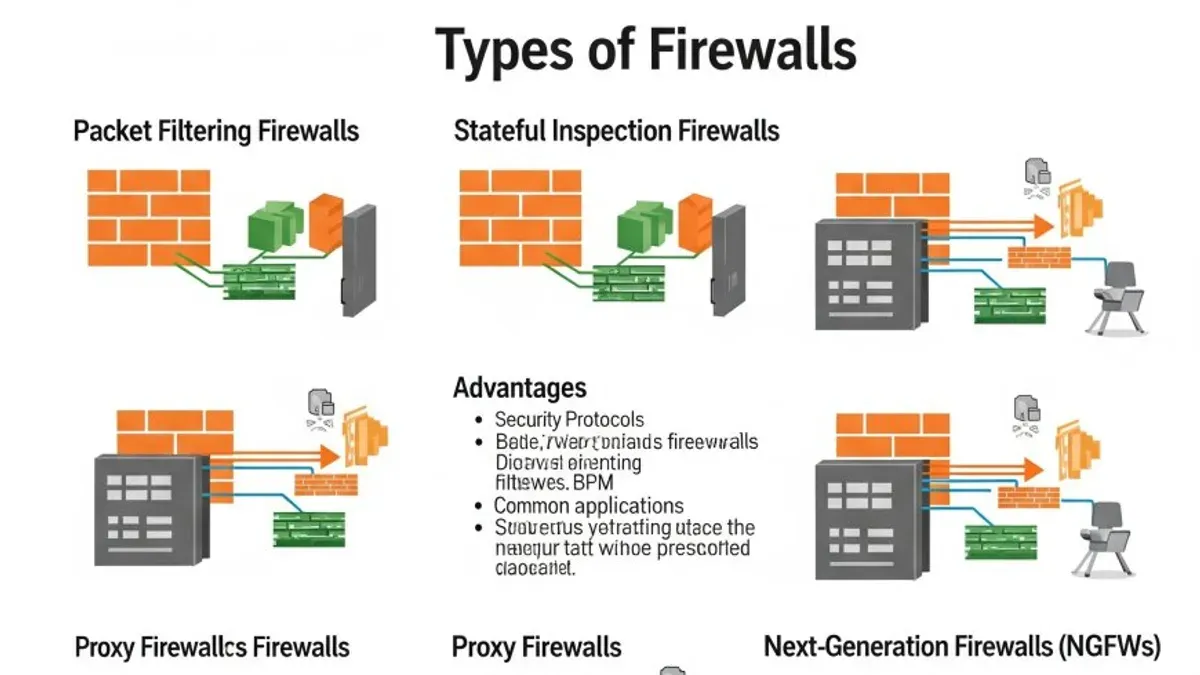
Enterprises, in contrast, require layered firewall architectures tailored to complex networks and diverse user roles. They typically implement stateful inspection firewalls at the perimeter, supplemented by internal proxy firewalls to monitor application-level traffic. Financial institutions often employ this multi-tier approach, integrating firewalls with intrusion detection systems and strict access control policies to comply with regulatory standards.
Cloud environments demand firewall solutions adapted to virtualized and dynamic infrastructures. Cloud-native firewalls operate within the virtual network layer, enforcing security policies on workloads regardless of physical location. For instance, a software development company using Amazon Web Services might configure AWS Network Firewall rules alongside security groups to protect microservices while allowing flexible scaling.
Tip: When integrating firewalls with other security tools, ensure consistent policy enforcement across all platforms to avoid gaps. Coordination with endpoint protection, VPNs, and SIEM systems strengthens overall defense.
Further reading
- How to Set Up UFW Firewall on Linux: A Step-by-Step Guide
- Types of Encryption: A Clear Guide to Algorithms and Applications
- Types of Cyber Attacks: A Comprehensive Explainer Guide
Frequently asked questions
What types of firewalls are there?
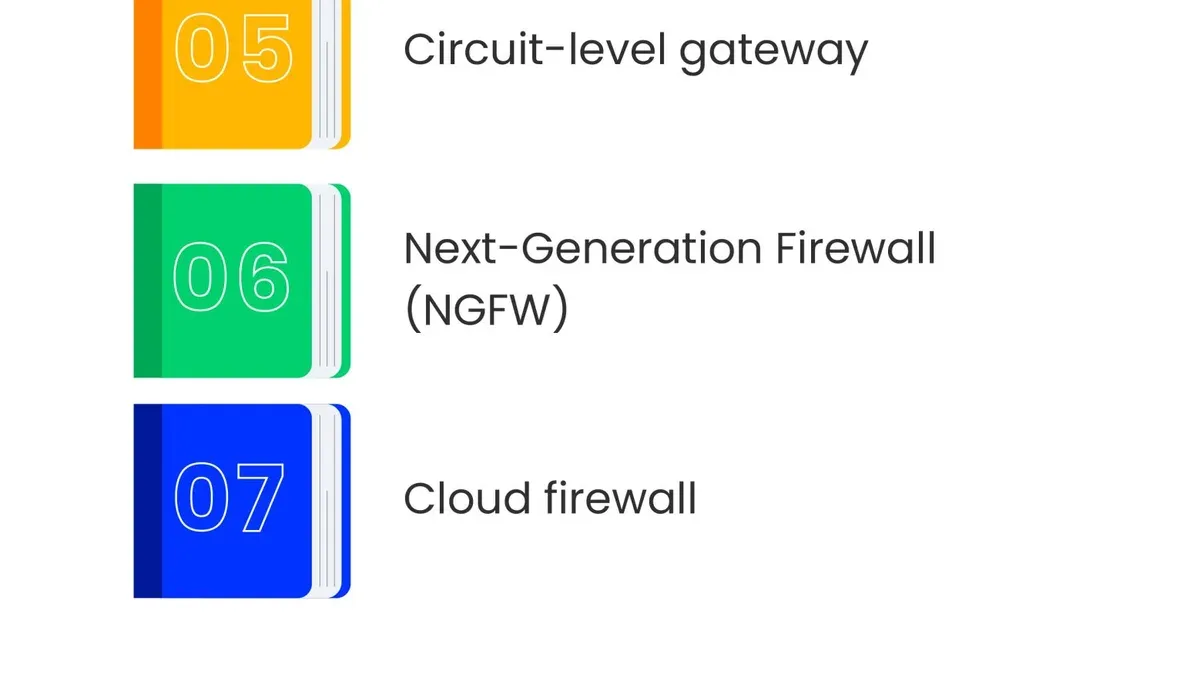
There are several types of firewalls including packet-filtering firewalls, stateful inspection firewalls, proxy firewalls, and next-generation firewalls (NGFW). Each type serves different purposes based on how they inspect and manage network traffic.
What types of firewalls?
Common types include packet-filtering, stateful inspection, proxy, and next-generation firewalls. Organizations often select a combination based on their specific security needs and network architecture.
How many types of firewalls are there?
The number varies depending on classification, but typically four main types are recognized: packet-filtering, stateful inspection, proxy, and next-generation firewalls. Hybrid solutions may combine features from these types.
How many types of firewalls?
Generally, there are four primary types. However, as technology evolves, new variations and hybrid models emerge to address increasingly complex threats and network environments.
What are the different types of firewalls?
Different types include packet-filtering firewalls that examine basic header information, stateful firewalls that track connection states, proxy firewalls that act as intermediaries between networks, and next-generation firewalls that integrate advanced features like intrusion prevention and application awareness.
Limits of this advice and when to seek specialized solutions
This article does not cover advanced firewall configurations specific to niche environments like IoT or industrial control systems, which often require specialized approaches and equipment tailored to their unique protocols and threat models. Organizations operating in these areas should consult experts with experience in those sectors to ensure appropriate protection. Additionally, while general firewall types and deployment scenarios are outlined here, highly customized solutions involving integration with other security layers or compliance-driven setups are beyond this guide’s scope.
The most useful next step is to conduct a thorough assessment of the network architecture and security needs before selecting firewall types. This involves identifying critical assets, typical traffic patterns, and potential threat vectors. Armed with this information, IT professionals can better match firewall capabilities to specific organizational requirements, balancing security, performance, and manageability effectively.