Understanding Types of VPN Protocols: A Clear Guide
This guide explains types of VPN protocols, their encryption, speed, and compatibility to help you select the right VPN setup.

This article explains the types of VPN protocols, detailing their technical aspects and practical applications to guide informed decisions for organizational or personal VPN setups.
VPN protocols define how data is securely transmitted between devices and networks, impacting speed, encryption strength, and compatibility. Understanding these protocols is essential for IT professionals and network administrators aiming to balance security requirements with performance needs. Common protocols include OpenVPN, IKEv2/IPSec, and WireGuard, each offering distinct advantages depending on the use case.
Choosing the right protocol involves assessing factors such as network environment, device support, and desired encryption levels. This guide offers a clear comparison of protocols, explains their encryption mechanisms, and highlights common pitfalls to avoid during configuration.
What are VPN protocols and why do they matter
VPN protocols are sets of rules and procedures that govern how data is securely transmitted over a virtual private network (VPN). They define methods for data encryption, authentication, and integrity checks, ensuring that information remains confidential and unaltered during transmission.
The choice of VPN protocol significantly affects connection speed, security strength, and device compatibility. For example, a protocol with strong encryption like AES-256 may provide robust security but could slightly reduce speed, whereas a lighter protocol might offer faster connections with somewhat less protection.
It is crucial to distinguish VPN protocols from VPN types. VPN types, such as remote access and site-to-site VPNs, describe the overall deployment model, while protocols determine how the data travels securely within these models.
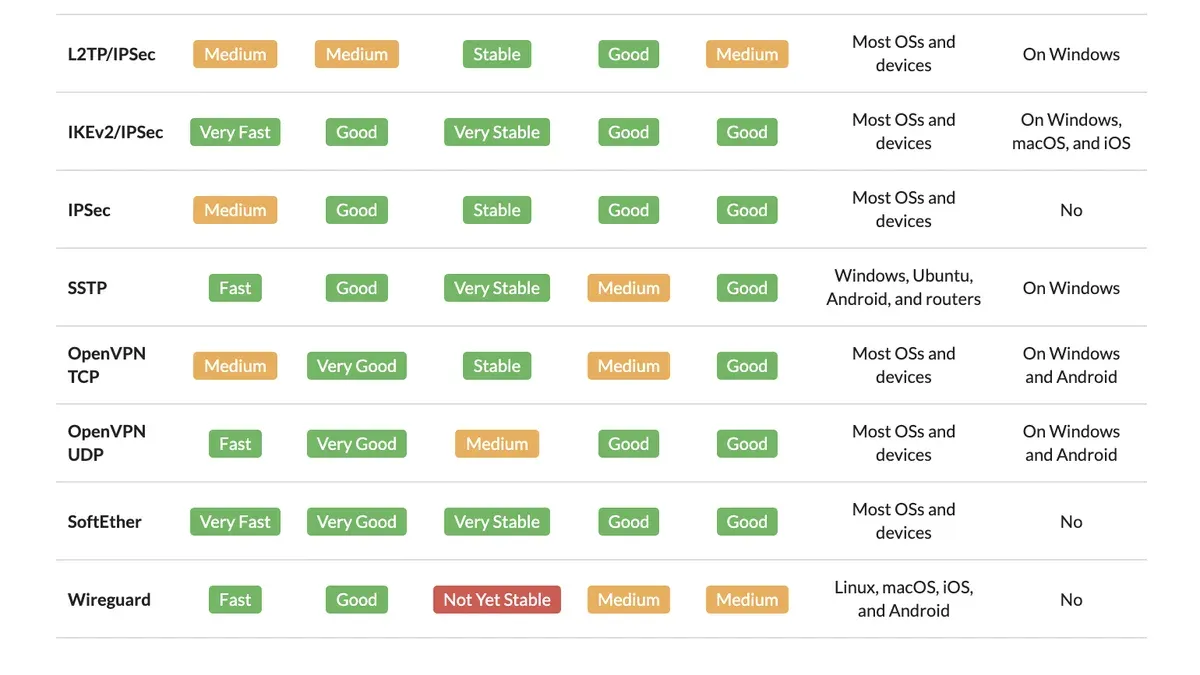
| Protocol | Encryption Strength | Connection Speed | Compatibility |
|---|---|---|---|
| OpenVPN | Strong (AES-256) | Moderate | High (Windows, macOS, Linux, iOS, Android) |
| IKEv2/IPsec | Strong (AES-256) | Fast | High (especially mobile devices) |
| PPTP | Weak (MPPE) | Very Fast | High but outdated |
For instance, an organization prioritizing high security for remote workers might select OpenVPN for its strong encryption and broad compatibility, even if it means accepting a moderate speed trade-off. Conversely, a scenario requiring quick reconnections on mobile networks might favor IKEv2/IPsec for its speed and stability.
Which are three popular VPN protocols and their key features
Among the many VPN protocols available, OpenVPN, IPSec, and WireGuard stand out for their widespread use and distinct characteristics.
OpenVPN
OpenVPN is an open-source protocol known for its strong security and high configurability. It supports a variety of encryption standards, including AES-256, and can operate over both TCP and UDP ports, allowing flexibility in adapting to different network environments. Its open-source nature means it undergoes regular security audits, contributing to robust trustworthiness. However, OpenVPN can be more complex to configure and may incur higher latency compared to newer protocols due to its heavier codebase.
IPSec
IPSec is a suite of protocols designed to secure Internet Protocol communications by authenticating and encrypting each IP packet. It is frequently paired with L2TP or IKEv2 to establish VPN tunnels. IPSec is widely implemented in enterprise environments and offers strong encryption with AES and support for various key exchange methods. While IPSec provides broad compatibility across devices, its performance can be impacted by network address translation (NAT) traversal issues, sometimes requiring additional configuration.
WireGuard
WireGuard is a newer VPN protocol designed for simplicity, speed, and modern cryptographic principles. It features a minimal codebase, which reduces attack surface and improves performance, often delivering lower latency and higher throughput than OpenVPN or IPSec in benchmark tests. WireGuard uses state-of-the-art cryptography such as Curve25519 for key exchange and ChaCha20 for encryption. However, as a relatively recent protocol, it has fewer deployment options and less mature support in some enterprise-grade VPN solutions.
Example: In a typical corporate VPN setup, OpenVPN might be chosen for its flexibility and audit history, IPSec with IKEv2 for device compatibility across mobile and desktop platforms, while WireGuard could be preferred in scenarios prioritizing speed and simplicity, such as remote worker access with minimal hardware.
Which protocol is used to secure VPNs and how encryption works
VPN protocols secure data transmission primarily through encryption, combining symmetric and asymmetric cryptographic techniques. Symmetric encryption, used for the bulk data transfer, relies on a shared secret key for both encryption and decryption. Asymmetric encryption, on the other hand, involves a public-private key pair and is mainly applied during initial key exchange to establish a secure connection.
Common symmetric algorithms include AES (Advanced Encryption Standard) and ChaCha20. AES is widely adopted for its balance of strong security and efficiency, often using 256-bit keys. ChaCha20 is favored in scenarios where performance on lower-power devices is critical, offering robust security with faster processing.
Handshake protocols play a crucial role in securely exchanging keys and authenticating parties. For example, OpenVPN uses TLS (Transport Layer Security) to perform a handshake that verifies server and client identities and negotiates encryption keys. IPSec employs IKEv2 (Internet Key Exchange version 2) to manage keys and security associations, ensuring that both endpoints agree on encryption parameters.
These handshake protocols defend against man-in-the-middle (MITM) attacks by authenticating the communicating endpoints through certificates or pre-shared keys. Additionally, mechanisms like sequence numbers and nonces help prevent replay attacks by ensuring each packet is unique and timely.
Example: When a user connects via OpenVPN, the client and server engage in a TLS handshake where the server presents its certificate. Once verified, they securely exchange symmetric keys used to encrypt the session. Data packets then flow encrypted with AES-256, while sequence numbers prevent replay attacks.
Diagram: A typical VPN encryption flow starts with the handshake (TLS or IKEv2), followed by symmetric encryption of the data tunnel, and includes authentication checks to maintain integrity and confidentiality.
What are the different VPN types and how they relate to protocols
VPNs primarily fall into two categories: remote access and site-to-site. Remote access VPNs enable individual users to securely connect to a corporate or private network from any location, often using devices like laptops or smartphones. Site-to-site VPNs link entire networks, such as branch offices to a central data center, allowing seamless and secure communication between locations.
Remote access VPNs commonly use protocols like OpenVPN or WireGuard due to their flexibility and compatibility with various client devices. For example, a consulting firm might deploy OpenVPN to allow employees working from home to access internal resources securely. The protocol’s support for NAT traversal and dynamic IP addresses suits the diverse environments encountered by remote users.
Site-to-site VPNs typically rely on IPSec, which offers robust security and is well-suited for fixed network endpoints with static IP addresses. A multinational company connecting its regional offices might use IPSec tunnels established between firewall devices at each location, ensuring encrypted traffic over the public internet without individual client configurations.
Choosing a VPN protocol depends on the VPN type and specific use case. Remote access scenarios prioritize client compatibility and ease of configuration, while site-to-site implementations emphasize stability and interoperability with network hardware.
How many types of VPN protocols exist and an overview beyond the popular ones
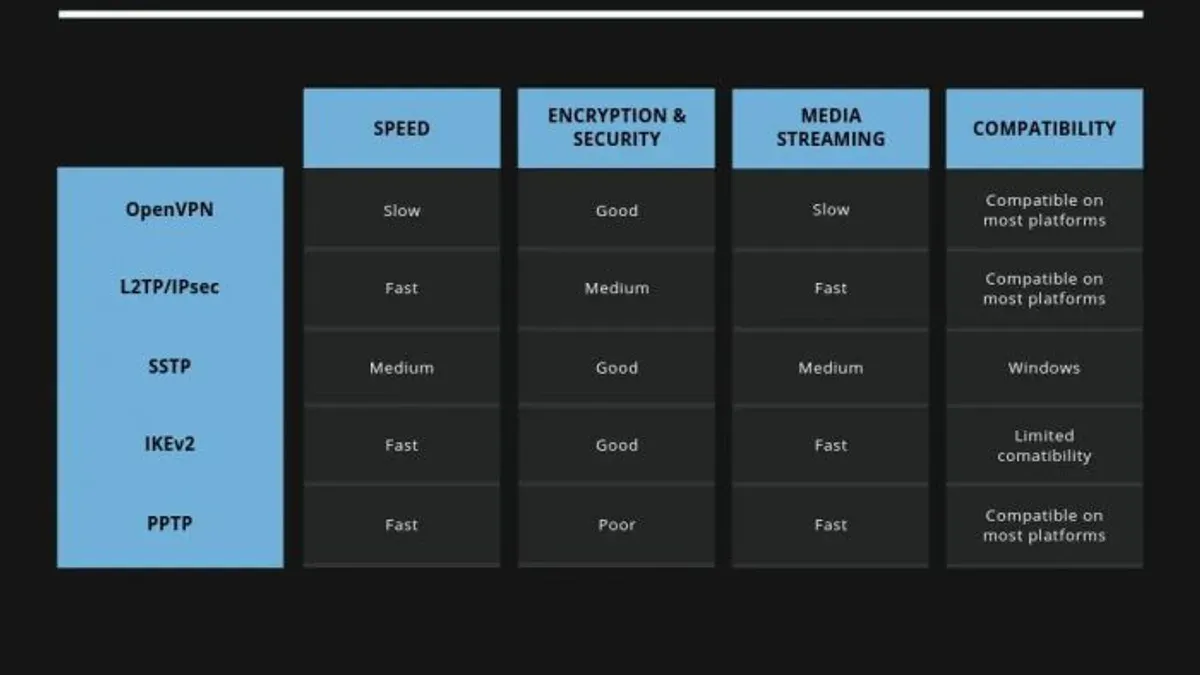
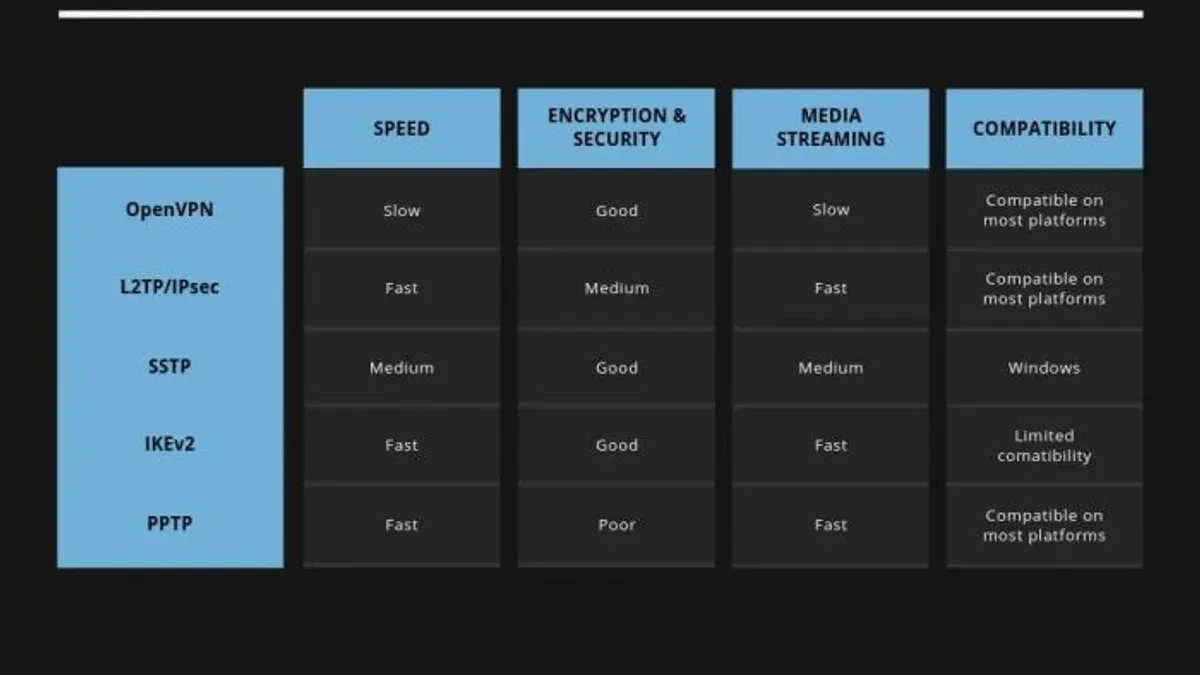
Beyond OpenVPN, IPSec, and WireGuard, several other VPN protocols have played important roles or serve niche use cases. PPTP (Point-to-Point Tunneling Protocol), introduced in the mid-1990s, was once widely used due to its simplicity and speed but is now largely deprecated because of serious security vulnerabilities. For example, PPTP’s MS-CHAPv2 authentication has been cracked, making it unsuitable for secure communications.
L2TP (Layer 2 Tunneling Protocol) often combines with IPSec to provide both tunneling and encryption, enhancing security compared to PPTP. L2TP/IPSec is still common in some enterprise setups where compatibility and moderate security are acceptable trade-offs.
SSTP (Secure Socket Tunneling Protocol) is a proprietary Microsoft protocol that uses SSL/TLS over TCP port 443, making it effective for bypassing firewalls that block other VPN protocols. This protocol is frequently found in Windows environments where seamless integration and firewall traversal are priorities.
IKEv2 (Internet Key Exchange version 2) excels in fast reconnection and stability, especially on mobile devices that switch networks frequently. Its ability to maintain VPN sessions during network changes makes it a favored choice for mobile professionals.
Emerging and specialized protocols continue to appear, such as proprietary solutions optimized for specific hardware or advanced cryptographic protocols aiming for post-quantum security. A practical scenario illustrating these choices is a multinational company using IPSec site-to-site tunnels for office connectivity, IKEv2 for employee mobile access, and SSTP for Windows-based remote workforces behind strict firewalls.
| Protocol | Introduction Era | Primary Use | Current Relevance |
|---|---|---|---|
| PPTP | 1990s | Simple tunneling | Deprecated due to weak security |
| L2TP/IPSec | Early 2000s | Tunneling + encryption | Moderate use in enterprises |
| SSTP | Mid-2000s | Firewall-friendly SSL-based | Used mainly in Windows environments |
| IKEv2 | Late 2000s | Fast reconnection, mobile-friendly | Popular for mobile and stable connections |
| WireGuard | 2018 | Modern, efficient VPN | Rapidly increasing adoption |
Tip: When selecting a VPN protocol, consider network environment constraints such as firewall restrictions and device mobility to ensure optimal protocol choice.
Types of protocols used in VPNs explained for network interviews and practical understanding
When preparing for network interviews or designing VPN solutions, understanding VPN protocols' technical specifics is crucial. Key characteristics include the transport layer they operate on (such as UDP or TCP), default port numbers (e.g., OpenVPN commonly uses UDP port 1194), and cross-platform support—for instance, WireGuard is supported natively in Linux kernels, while IPSec enjoys broad compatibility across Windows, macOS, and mobile OS.
Typical interview questions might ask to compare protocols by speed, security, or use cases. For example: "Which VPN protocol uses UDP port 500 and 4500, and what does it provide?" The answer is IPSec, which uses these ports for IKE and NAT traversal, offering site-to-site connectivity and strong encryption.
Understanding protocol layers aids troubleshooting. OpenVPN runs at the application layer, making it easier to configure behind firewalls, while IPSec operates at the network layer, sometimes requiring additional NAT traversal steps. Misconceptions include assuming WireGuard lacks encryption—it uses modern cryptography but is lightweight and efficient.
Protocol comparison matrix example:
| Protocol | Transport Layer | Default Ports | OS Support | Use Case |
|---|---|---|---|---|
| OpenVPN | UDP/TCP | UDP 1194 | Windows, macOS, Linux, iOS, Android | Remote access, flexible firewall traversal |
| IPSec | Network (IP) | UDP 500, 4500 | Broad (including routers) | Site-to-site, corporate VPNs |
| WireGuard | UDP | UDP 51820 (default) | Linux (native), Windows, macOS, mobile | High-performance remote access |
For example, during troubleshooting, a network admin might check if UDP port 1194 is blocked when OpenVPN fails to connect. Understanding the protocol’s transport layer and port requirements speeds diagnosis. In interviews, articulating such examples showcases practical knowledge beyond theory.
Practical considerations for choosing the right VPN protocol
Selecting a VPN protocol requires balancing security needs against performance demands. For example, OpenVPN provides robust security but can be slower due to its encryption overhead, while WireGuard offers faster speeds with a modern cryptographic approach, though it may have limited support on older devices.
Device and operating system compatibility is crucial; IPSec is widely supported across Windows, macOS, iOS, and Android, making it a versatile choice for diverse environments. Conversely, some protocols require additional client software, adding complexity to deployment and maintenance.
Corporate compliance and regulatory requirements also influence protocol choice. Organizations handling sensitive data may prioritize protocols with strong encryption and audit capabilities, such as those conforming to FIPS standards, even if it means sacrificing some speed or ease of use.
On mobile devices, consider the protocol's impact on battery life and resource consumption. WireGuard’s lightweight codebase often results in lower power usage compared to more resource-intensive protocols like OpenVPN, which can affect device longevity during extended VPN use.
Example: A company with remote employees using a mix of laptops and smartphones might select WireGuard for its speed and battery efficiency but pair it with IPSec fallback to ensure compatibility with legacy devices. This approach balances user experience with broad device support.
Common mistakes to avoid when selecting or configuring VPN protocols
One frequent mistake is continuing to use deprecated protocols like PPTP despite well-documented vulnerabilities, such as weak encryption and susceptibility to interception. For instance, organizations that relied on PPTP faced breaches where attackers exploited its weak MS-CHAPv2 authentication, leading to unauthorized data access.
Another common error is ignoring protocol compatibility with the existing devices or network infrastructure. Deploying a protocol unsupported by key endpoints or routers can cause connection failures or degraded performance, as seen when mobile devices lack native support for certain protocols like IKEv2 without additional client software.
Misconfiguring encryption parameters is also a critical issue. Settings such as selecting outdated cipher suites (e.g., 3DES instead of AES) or disabling Perfect Forward Secrecy can severely weaken security, leaving VPN tunnels vulnerable to cryptanalysis or replay attacks.
Overlooking the need for regular updates and patches for VPN software and protocol implementations opens doors for exploitation of known vulnerabilities. For example, failure to apply timely patches to OpenVPN or WireGuard clients has allowed attackers to gain unauthorized access through resolved bugs.
Tip: Always verify protocol support across all devices, use strong, current encryption settings, and maintain up-to-date VPN software to prevent common security pitfalls.
Further reading
Frequently asked questions
What protocols are used in vpn?
VPNs commonly use protocols such as OpenVPN, IPsec, L2TP, PPTP, and WireGuard. Each protocol has distinct characteristics regarding security, speed, and compatibility, influencing their suitability for different scenarios.
Which two types of vpns are examples?
Two common types of VPNs are Remote Access VPNs, which allow individual users to connect securely to a private network, and Site-to-Site VPNs, which link entire networks across multiple locations securely over the internet.
What are the types of vpn?
VPN types include Remote Access VPN, Site-to-Site VPN, Mobile VPN, and Client-to-Site VPN. These types differ based on their use cases, such as individual user connections versus network-to-network communications.
What protocol does vpn use?
VPNs use a variety of protocols depending on the required balance between security and speed. Common protocols include IPsec for secure network connections, OpenVPN for flexibility and strong encryption, and WireGuard for high performance and modern cryptography.
What types of protocols are used in vpn?
VPN protocols fall mainly into categories like tunneling protocols (e.g., PPTP, L2TP) and security protocols (e.g., IPsec, SSL/TLS). Recent additions like WireGuard combine both tunneling and encryption with streamlined code for efficiency.
Limits of this advice and when to seek specialized guidance
This article does not cover specific VPN service providers or their proprietary protocol implementations; readers should evaluate protocols in the context of their VPN provider's offerings. Performance and security can vary widely depending on implementation details beyond the protocol itself. Certain protocols may not be suitable for highly sensitive environments requiring government-grade security, where specialized solutions and expert consultation are recommended.
For those implementing or managing VPNs, the most useful next step is to test multiple protocols within their own network environment, focusing on the balance of security, speed, and compatibility that best fits their operational requirements. Monitoring real-world performance and adjusting configurations accordingly helps ensure the chosen protocol meets both technical and organizational needs.