Best Certifications for Cryptographer in 2026: Expert Guide to Career and Skills
Explore top certifications for cryptographer to enhance skills and career prospects in cybersecurity and cryptography for 2026.

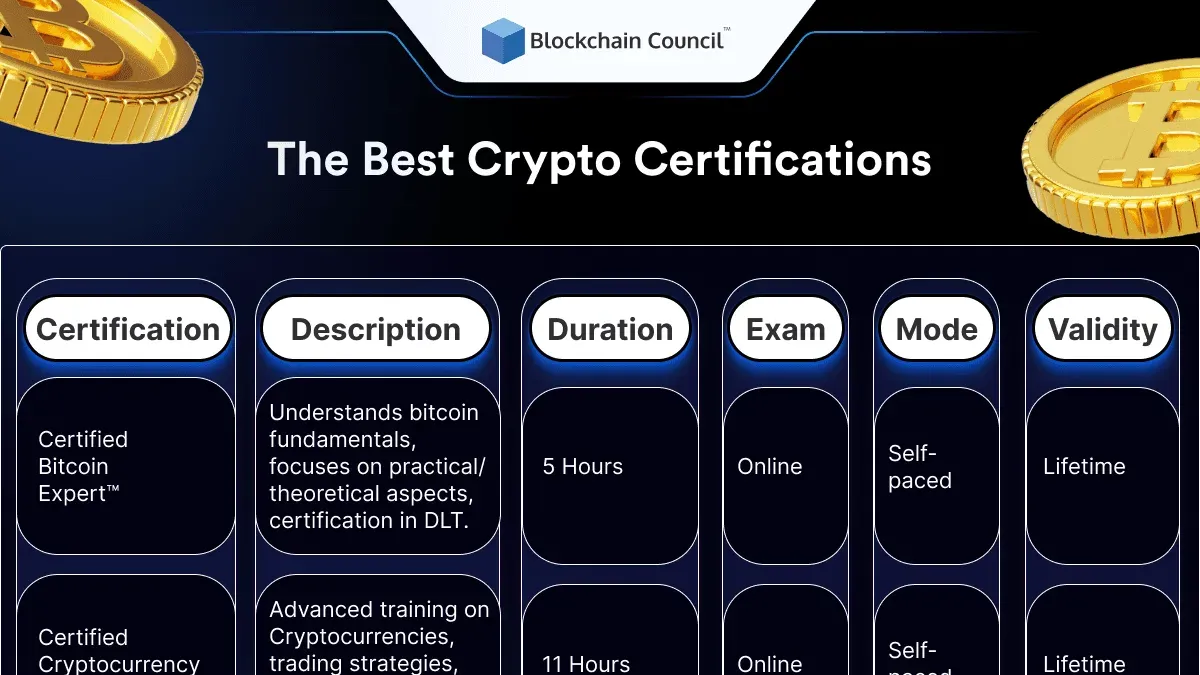
This article provides a comprehensive guide to the best certifications for cryptographer in 2026, helping aspiring cryptographers and cryptologists navigate career and educational choices effectively.
Cryptography remains a cornerstone of cybersecurity, with increasing demand for professionals skilled in securing communications and data. Choosing the right certification can significantly impact career prospects, as certifications validate expertise in cryptographic principles, algorithms, and practical applications. This guide ranks certifications based on industry recognition, relevance to current cryptographic challenges, and alignment with career goals in 2026.
Whether pursuing roles in government, private sector security, or research, understanding which certifications provide practical skills and credible credentials is essential. The article also addresses foundational knowledge and complementary certifications that enhance professional growth in the cryptography field.
How to become a cryptographer
Entering the cryptography field typically begins with formal education. A bachelor’s degree in computer science, cybersecurity, or mathematics suits those seeking a broad foundational knowledge. Its strength lies in providing essential skills in algorithms and programming, but its drawback is limited specialized cryptography content. For deeper expertise, a master’s degree specialized in cryptography or information security fits individuals aiming for advanced roles. This path offers focused study on encryption techniques and security protocols, though it requires additional time and financial investment.
Strong foundational knowledge in mathematics, including number theory and discrete math, is critical for understanding cryptographic algorithms. This suits learners comfortable with abstract reasoning, with the strength of enabling deeper algorithm comprehension; however, it can be challenging for those without a math background.
Practical experience through internships or research projects is vital for skill application. Internships in cybersecurity firms or research labs suit students and early professionals by providing hands-on exposure. Their strength is real-world problem solving, while the drawback is competition and limited availability.
Certifications complement formal education by validating skills and improving job prospects. Certifications like Certified Encryption Specialist (EC-Council) suit professionals seeking recognized credentials. They offer industry acknowledgment but may require ongoing renewal and costs.
Many universities offer cryptography-focused programs. Examples include Johns Hopkins University’s M.S. in Security Informatics and the University of Maryland’s Cryptography track in computer science. Graduates from such programs tend to have favorable employment outcomes in cybersecurity roles, though precise statistics vary by region and institution.
Is cryptography a good career in 2026
Cryptography remains a highly relevant and sought-after career in 2026, driven by increasing cybersecurity needs across multiple sectors. In government agencies, cryptographers support national security and intelligence efforts, making it suitable for those interested in public service and sensitive data protection. A key strength is the critical role in safeguarding classified information, but the drawback includes navigating complex bureaucracy and security clearance requirements.
The finance industry also demands cryptography expertise to secure transactions and protect customer data. This sector suits professionals focused on practical cryptographic applications in digital payments and blockchain technologies. High earning potential and clear career advancement pathways are strong advantages, while the fast-paced regulatory environment can pose ongoing challenges.
Technology companies employ cryptographers to develop secure software and hardware solutions, appealing to innovators interested in cutting-edge encryption methods. The strength lies in working with emerging technologies and diverse projects, but the rapid evolution of threats requires continuous learning and adaptation.
Compared to other cybersecurity roles such as penetration testers or network security analysts, cryptographers often command higher salaries and specialize in algorithm design and cryptanalysis. However, this specialization can limit job flexibility. Demand trends indicate steady growth, reflecting an expanding need for cryptographic skills in securing data and communications.
Tip: Aspiring cryptographers should be prepared for lifelong learning to keep pace with evolving cryptographic standards and threat landscapes.
What is the best cryptography algorithm
Cryptographic algorithms fall mainly into two categories: symmetric and asymmetric. Symmetric algorithms use the same key for encryption and decryption, while asymmetric algorithms rely on a pair of related keys, public and private.
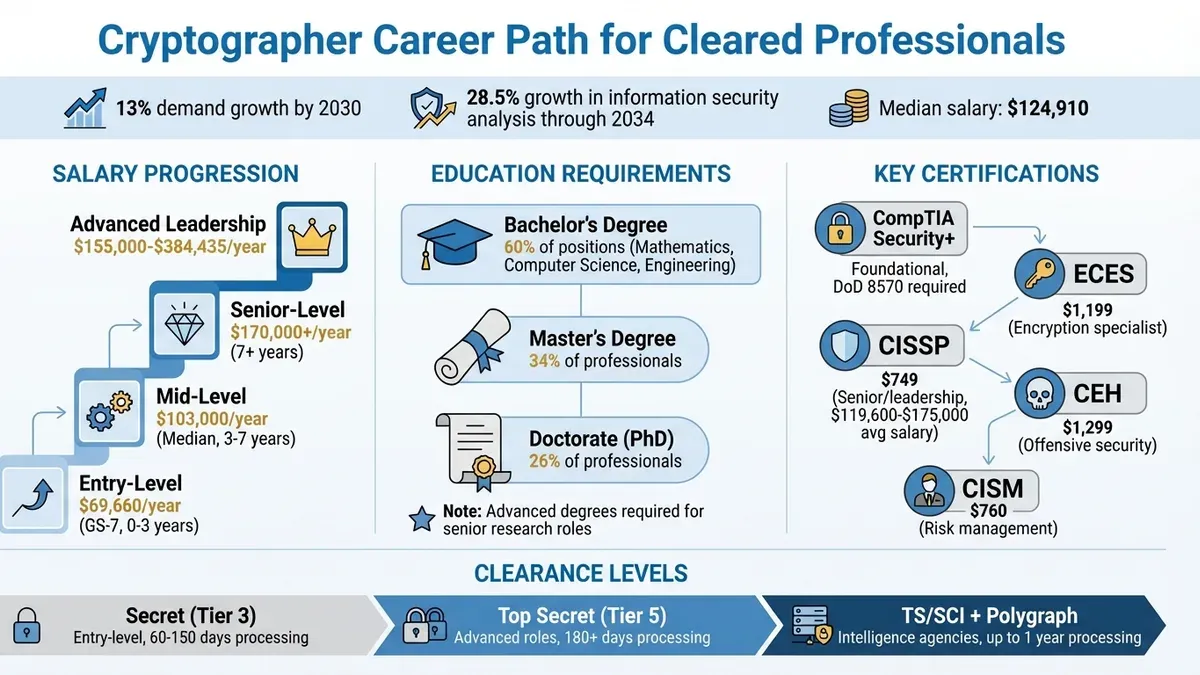
Advanced Encryption Standard (AES) is the leading symmetric algorithm widely adopted for data encryption. It suits applications requiring fast, secure bulk data protection, such as disk encryption and secure communications. Its main strength is efficiency combined with strong security, backed by extensive analysis and standardization. However, key distribution remains a challenge as both parties must share the same secret key securely.
RSA is a classic asymmetric algorithm primarily used for secure key exchange and digital signatures. It fits scenarios where secure communication over an untrusted channel is needed. RSA’s strength lies in its well-studied security and broad adoption. Its drawback is slower performance compared to symmetric algorithms, making it less ideal for encrypting large data volumes.
Elliptic Curve Cryptography (ECC) offers asymmetric encryption with smaller key sizes than RSA, making it suitable for resource-constrained environments like mobile devices and IoT. ECC’s advantage is efficiency in computation and reduced bandwidth. The downside is increased algorithmic complexity and less familiarity among some practitioners.
Post-quantum algorithms are an emerging class designed to resist attacks by quantum computers. These algorithms, such as lattice-based cryptography, are becoming a focus in cryptographic standards and future-proofing efforts. Their strength is future security assurance, but they currently face challenges in performance optimization and standard adoption.
The choice of algorithm depends on the use case—whether encrypting data, authenticating users, or securing key exchange. Certifications in cryptography increasingly emphasize understanding these distinctions and current standards to prepare professionals for evolving industry requirements.
How to learn cryptography effectively
Acquiring cryptography knowledge in 2026 involves a balanced mix of theoretical study and practical application. Online courses remain a popular starting point. For example, Coursera's "Cryptography I" by Stanford University suits beginners; it offers clear explanations and hands-on assignments but can be time-consuming. Another top-rated course is Udemy's "Applied Cryptography and Network Security" for intermediate learners, praised for its real-world focus but occasionally criticized for depth inconsistency.
Books provide foundational depth. "Cryptography Engineering" by Ferguson, Schneier, and Kohno is ideal for those with basic knowledge, offering practical insights but requiring some prior understanding. "Introduction to Modern Cryptography" by Katz and Lindell caters to intermediate readers with a strong mathematical approach; however, its density can be challenging for novices.
Hands-on practice is crucial. Implementing algorithms like AES or RSA in programming languages such as Python enhances comprehension and exposes subtleties not evident in theory. Utilizing platforms like Cryptopals challenges learners with progressively difficult crypto problems, but requires patience and persistence.
Leveraging digital certificates and practical labs, including virtual lab environments and sandboxed PKI setups, validates skills and simulates real-world cryptographic deployments. These labs suit those seeking career readiness, though access to advanced labs may involve subscription fees.
Tip: Combining structured courses, authoritative books, and consistent coding practice forms the most effective path to mastering cryptography in 2026.
How to become a cryptologist
Cryptologists focus broadly on the study of codes and ciphers, encompassing both the creation and analysis of cryptographic systems, while cryptographers primarily design and implement these systems. This distinction means cryptologists often engage in codebreaking and cryptanalysis, alongside development.
Educational requirements
A bachelor’s degree in computer science, mathematics, or information security is a common starting point for both roles. However, cryptologists frequently pursue a master’s degree specializing in cryptology or applied mathematics to deepen analytical skills. This advanced study suits those aiming for research or intelligence positions but can extend the time and financial investment before entering the workforce.
Specialized certifications and training
Certifications such as the Certified Encryption Specialist (EC-Council) offer practical cryptography skills useful to both cryptologists and cryptographers. The GIAC Cryptologic Technician certification targets cryptologic technicians and analysts, emphasizing code analysis and signals intelligence, ideal for government or military careers. While certifications provide focused skill validation, they may require ongoing renewal and practical experience to remain relevant.
Career pathways and typical employers
Cryptologists often find roles in government agencies like the NSA or intelligence services, defense contractors, and academic research institutions. Cryptographers are more commonly employed by private sector companies in cybersecurity, finance, and technology. Government roles provide access to classified projects and high-impact work but typically demand security clearances and can have limited public visibility.
Best certifications for cryptographer in 2026
The Certified Encryption Specialist (CES) is designed for professionals seeking foundational expertise in encryption technologies and practical cryptographic implementation. It suits entry to mid-level candidates aiming to validate core cryptography skills. Strengths include a focused syllabus on symmetric and asymmetric encryption and a generally accessible pass rate. The drawback is that it may lack depth in advanced cryptanalysis or emerging algorithmic trends.
The GIAC Cryptographic Technician (GCT) targets cybersecurity professionals who require hands-on cryptographic application knowledge with a strong emphasis on real-world scenarios. It suits those working in operational roles or security engineering. Its strength is practical skill validation with employer recognition in the cybersecurity community. However, the cost and renewal requirements can be higher compared to foundational certifications.
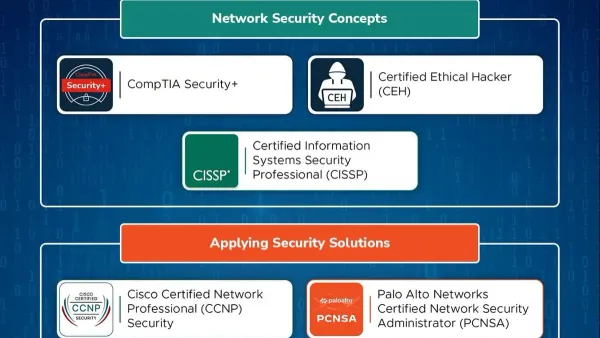
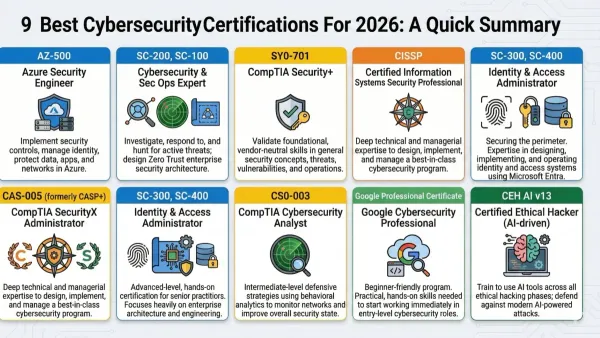
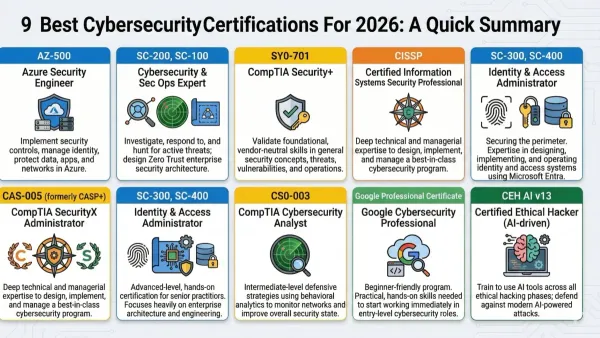
The Certified Information Systems Security Professional (CISSP) with a cryptography focus is a broad, well-recognized certification incorporating comprehensive security domains including cryptography. It is ideal for senior professionals or managers who need both strategic and technical cryptography insight. Strengths lie in its industry-wide recognition and integration with other security disciplines. The main drawback is the broad scope, which may dilute deep cryptographic specialization.
The CompTIA Security+ certification with cryptography modules is suitable for newcomers to cybersecurity who want a balanced introduction to cryptography within general security concepts. Its strengths include affordability, ease of access, and vendor neutrality. The limitation is a relatively shallow coverage of cryptographic theory and algorithms compared to specialized certifications.
Specialized post-quantum cryptography certifications emerging in 2026 focus on skills related to quantum-resistant algorithms and future-proof cryptographic standards. They suit advanced cryptographers and researchers preparing for next-generation security challenges. Their strength is cutting-edge syllabus content addressing imminent industry shifts. The catch is limited availability, evolving exam standards, and currently lower employer awareness.
What are good cybersecurity certifications related to cryptography
Several cybersecurity certifications include essential cryptography knowledge, making them valuable for professionals who want to integrate cryptographic principles into broader security roles.
Certified Ethical Hacker (CEH)
The CEH certification focuses on identifying vulnerabilities and weaknesses in systems, including cryptographic protocols. It suits security professionals aiming to understand cryptography as part of offensive security strategies. A strength of CEH is its practical approach to security testing, including cryptography-related exploits. However, its coverage of cryptography is more introductory and less in-depth compared to specialized cryptography certifications.
Certified Cloud Security Professional (CCSP)
CCSP targets professionals managing cloud security risks, with a significant component on cryptography for data protection in cloud environments. It is ideal for those combining cryptography knowledge with cloud infrastructure security. The certification’s strength lies in its relevance to current cloud security practices, including encryption standards and key management. A drawback is that the cryptography content is tailored to cloud contexts, which might not cover all cryptographic fundamentals comprehensively.
Tip: These certifications complement cryptography-specific credentials by broadening the practical application of cryptographic skills within security frameworks.
Understanding digital certificates and certificates in cryptography
Digital certificates are electronic documents used to prove the ownership of a public key within a cryptographic system. They form a core component of Public Key Infrastructure (PKI), which enables secure communication over networks by verifying identities and encrypting data. PKI relies on trusted entities known as Certificate Authorities (CAs) that issue and manage these certificates.
Digital certificates suit cybersecurity professionals and cryptographers working with secure communications, encryption protocols, or identity verification systems. Their key strength lies in enabling trust between parties without prior direct contact, such as securing websites with HTTPS or validating software authenticity. A notable drawback is that the security of the system depends heavily on the trustworthiness and vulnerability of the issuing Certificate Authorities; a compromised CA can undermine the entire PKI.
In contrast, certification courses are educational credentials that validate a professional's knowledge or skills in cryptography or cybersecurity. These suit individuals seeking career advancement or specialized expertise. Their primary strength is structured learning with industry recognition, but a drawback is that they do not grant any cryptographic functionality or system trust inherently.
Understanding digital certificates is critical for cryptography professionals because managing and verifying these certificates affects the security of encrypted systems. Mismanagement can lead to vulnerabilities such as man-in-the-middle attacks or unauthorized data access. For example, HTTPS uses digital certificates to authenticate websites, while email encryption solutions rely on certificates to secure messages.
Tip: Visualizing PKI workflows helps clarify the roles of CAs, digital certificates, and end-users in maintaining secure cryptographic communications.
Further reading
- Best Certifications for AI Security Researchers in 2026
- AI Security Researcher Resume Example and Guide for Effective Screening
- Key AI Security Researcher Interview Questions and How to Answer Them
Frequently asked questions
What are good cyber security certifications?
Good cybersecurity certifications in 2026 include Certified Information Systems Security Professional (CISSP), Certified Ethical Hacker (CEH), and CompTIA Security+. These certifications cover a broad range of cybersecurity topics, including cryptography, risk management, and network security. Additionally, specialized credentials like Certified Encryption Specialist (EC-Council) focus more deeply on cryptography-related skills.
Why do we need cryptography?
Cryptography is essential for securing communication and protecting sensitive data from unauthorized access. It enables confidentiality, data integrity, authentication, and non-repudiation in digital transactions. Without cryptography, modern digital systems, including online banking, confidential communications, and data storage, would be vulnerable to cyber threats.
Why is cryptography important?
Cryptography underpins the security framework of digital systems by ensuring that information remains private and trustworthy. It prevents data breaches, supports secure authentication, and enables safe electronic commerce. The growing complexity of cyber threats in 2026 makes cryptography a critical element in cybersecurity defenses.
What is a certificate in cryptography?
A certificate in cryptography typically refers to a digital certificate, which is an electronic document used to prove ownership of a public key. It is issued by a trusted Certificate Authority (CA) and binds a public key to an entity's identity, enabling secure encryption and authentication online. Digital certificates are fundamental to protocols like SSL/TLS for secure internet connections.
Which choice is a valid cryptographic cipher?
Valid cryptographic ciphers include Advanced Encryption Standard (AES), Rivest-Shamir-Adleman (RSA), and Elliptic Curve Cryptography (ECC). AES is widely used for symmetric encryption, while RSA and ECC are common asymmetric algorithms. Selecting a cipher depends on the security requirements and computational resources available.
Limits of This Advice
This article focuses on certifications and educational paths relevant to 2026 and may not cover emerging certifications beyond this date. Certification alone does not guarantee job placement; practical experience and continuous learning are equally vital. Some certifications may be more recognized in certain regions or industries, so readers should consider their target job market before committing.
The most effective next step for aspiring cryptographers is to combine certification efforts with hands-on projects or internships that demonstrate applied cryptographic skills. Engaging with real-world challenges, such as contributing to open-source cryptography libraries or participating in security-focused competitions, enhances understanding and employability significantly more than certification alone.