AI Security Researcher Resume Example and Guide for Effective Screening
Learn how to create an AI security researcher resume example optimized for AI screening and human recruiter evaluation.

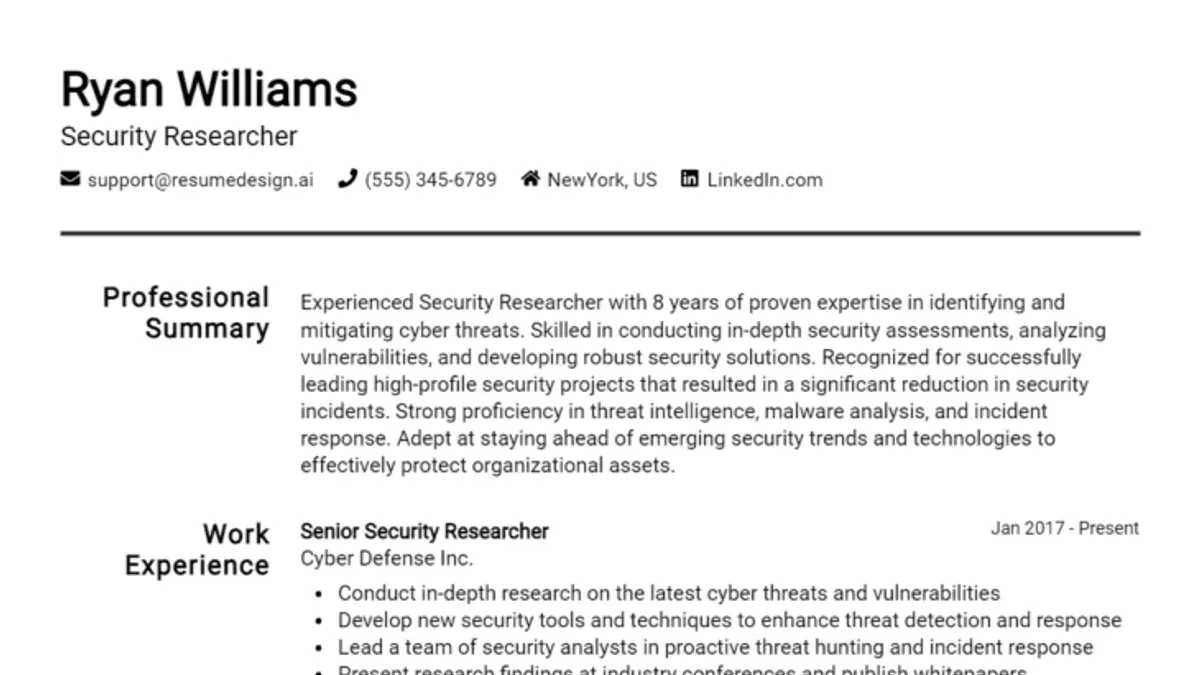
This article provides a comprehensive guide on crafting an AI security researcher resume example tailored to succeed in both AI-driven applicant tracking systems and human recruiter evaluations.
AI security researcher roles require resumes that clearly demonstrate technical expertise while aligning with automated screening algorithms. Understanding how AI tools parse keywords, assess qualifications, and flag inconsistencies is crucial for candidates aiming to advance their careers.
The article explains the mechanics of AI resume screening, strategies to optimize content and formatting, and methods to identify AI-generated resume elements. This balanced approach helps candidates navigate the challenges of dual evaluation processes and make informed decisions about resume presentation.
What is an AI resume and why it matters for AI security researchers
An AI resume is a curriculum vitae specifically optimized to be effectively evaluated by artificial intelligence-driven applicant tracking systems (ATS). These systems scan resumes for relevant keywords, formats, and structures before a human recruiter reviews them. For AI security researchers, whose roles blend technical expertise with emerging AI technologies, crafting an AI resume means aligning both the content and presentation with the expectations of automated screening tools.
AI screening tools are now widely deployed in technology and cybersecurity hiring processes, often filtering out a large portion of applications before human eyes see them. While exact usage rates vary, it is common for companies recruiting AI security researchers to rely heavily on ATS platforms to manage high applicant volumes and identify candidates with precise skill sets.
Keywords such as "machine learning security," "adversarial AI techniques," "threat modeling," "vulnerability assessment," and "secure AI deployment" are crucial for passing initial AI screening stages. For example, a resume that highlights experience with "penetration testing of AI models" and "developing defenses against model poisoning attacks" is more likely to be flagged as relevant by an ATS tailored for AI security roles.
Tailoring resumes for AI screening does not mean ignoring human recruiters. The ideal AI resume balances keyword optimization with clear, concise descriptions of achievements and skills, ensuring readability and credibility when reviewed by technical hiring managers. This dual focus enhances the chance of progressing through both machine and human evaluation phases in competitive AI security researcher job markets.
How does AI screen resumes for AI security researcher roles
AI screening tools for AI security researcher resumes primarily rely on parsing and keyword matching to identify relevant qualifications. Applicant tracking systems (ATS) extract structured data such as job titles, education, and certifications by breaking down resume text into fields. For example, tools like Greenhouse and Lever parse resumes to isolate technical skills like "penetration testing," "threat modeling," or "cryptography." Keywords must appear in context to pass filters aligned with job descriptions.
Natural language processing (NLP) enhances screening by evaluating the semantic relevance of skills and experience. This means AI can recognize variations such as "vulnerability assessment" versus "security auditing," and rank candidates based on how closely their experience matches the role. Some ATS platforms integrate AI modules to score resumes on criteria including years of experience, project impact, and familiarity with security frameworks like NIST or MITRE ATT&CK.
Common AI screening filters include minimum educational requirements (e.g., a degree in computer science or cybersecurity), industry certifications such as CISSP or CEH, and proficiency in programming languages like Python or C++. The AI also flags resumes lacking these elements for lower ranking or rejection.
However, AI screening exhibits limitations. Bias can arise if training data overemphasizes traditional credentials, potentially overlooking candidates with non-traditional but relevant backgrounds. Parsing errors may misinterpret formatting or jargon unique to security research, affecting accuracy. For instance, a candidate using less common acronyms might be scored lower despite relevant expertise.
Example: A resume listing "Conducted adversarial machine learning experiments to detect AI model vulnerabilities" will be scored higher by NLP-enabled ATS than one with generic terms like "security testing," because the AI identifies the specific relevance to AI security research.
How to get through AI resume screening for AI security researcher jobs
To successfully navigate AI resume screening, candidates should start by incorporating relevant keywords naturally from the job description. For example, if a posting emphasizes “threat modeling,” “cryptographic protocols,” and “vulnerability assessment,” these exact phrases should appear seamlessly in the resume text rather than as a disconnected list.
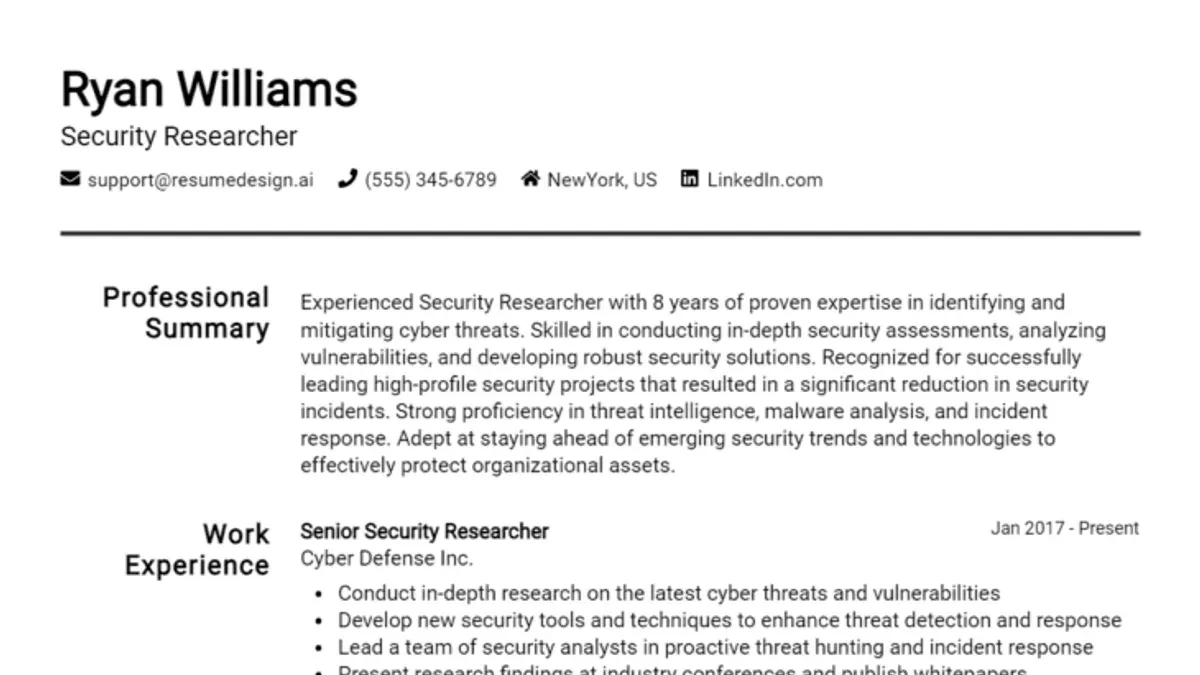
Formatting plays a crucial role in ATS readability. Resumes should avoid images, graphics, and complex tables since many ATS tools cannot parse them correctly. Using standard headings such as "Experience," "Education," and "Skills" ensures the system categorizes information properly. Simple bullet points and consistent font styles improve clarity for both AI and human reviewers.
Highlighting measurable achievements and relevant projects strengthens a resume’s impact. Instead of stating “worked on intrusion detection,” a more effective phrase would be “developed and deployed an intrusion detection system that reduced false positives by 30%.” This quantification helps AI algorithms and recruiters quickly assess value.
Balancing specialized technical jargon with clear language is essential. While technical terms demonstrate expertise, overly dense language can confuse ATS and human readers alike. For instance, pairing “implemented multi-factor authentication (MFA) solutions” with a brief explanation of the technology’s purpose can improve comprehension.
Before-and-after resume snippet
Before: “Performed security analysis and vulnerability testing on software systems.”
After: “Conducted comprehensive vulnerability assessments using OWASP methodologies, identifying 15 critical security flaws and reducing potential exploits by 40%.”
This revised example integrates targeted keywords, quantifies achievements, and clarifies technical contributions, improving the chances to pass AI screening and impress recruiters.
How to do an AI resume tailored to AI security researcher careers
Structuring a resume for AI security researcher roles requires prioritizing clarity and ATS compatibility. Recommended sections, in order, include Contact Information, Professional Summary, Skills, Experience, Education, Certifications, and Publications. This sequence ensures both AI screening tools and human recruiters can quickly locate relevant information.
The Skills section should emphasize expertise in machine learning algorithms, threat modeling, cryptography techniques, security protocols, and programming languages such as Python and C++. Including specific tools like TensorFlow, PyTorch, or security frameworks strengthens credibility.
Certifications such as Certified Information Systems Security Professional (CISSP) or Certified Ethical Hacker (CEH) and relevant publications in AI security journals or conference proceedings add significant value. These demonstrate both knowledge and active engagement in the field.
Using action verbs—developed, implemented, analyzed—and quantifiable outcomes helps communicate impact effectively. For example, rather than stating "worked on threat detection," a stronger phrase is "developed a machine learning-based threat detection system reducing false positives by 30%."
Consider this sample outline:
- Contact Information: Name, phone, email, LinkedIn, GitHub
- Professional Summary: Concise statement highlighting AI security expertise and key achievements
- Skills: Machine learning, cryptography, threat modeling, Python, TensorFlow
- Experience: Job title, employer, dates, bullet points with action verbs and quantifiable results
- Education: Degree, institution, graduation date
- Certifications: CISSP, CEH, or specialized AI security credentials
- Publications: Titles, venues, dates relevant to AI security research
Tip: Tailor the Skills and Experience sections for each application, aligning keywords with the job description while maintaining natural language.
How to detect AI-generated content in resumes and why it matters
AI-generated resume content often exhibits telltale signs such as overly generic phrasing, repetitive sentence structures, or inconsistent details. For example, a resume might state: "Possesses strong skills in cybersecurity and problem solving," which is vague and lacks specificity compared to a human-written line like: "Developed a machine learning model that reduced threat detection time by 30%." Such generic statements can raise suspicion during screening.
Recruiters increasingly use AI detection software that analyzes text patterns, linguistic style, and metadata to differentiate between human and machine-generated content. Tools like GPTZero and OpenAI’s classifier examine aspects such as perplexity and burstiness to flag AI-originated text. These technologies are not flawless but provide useful indicators to guide further scrutiny.
Ethically, submitting AI-generated resumes without disclosure can risk credibility and trust. If detected, candidates may face negative consequences including disqualification or reputational damage. Moreover, reliance on AI-generated content can mask a candidate's genuine skills and experiences, undermining fair assessment.
Maintaining authenticity involves tailoring resumes with personal accomplishments, precise technical details, and clear examples of work impact. Candidates should review and refine any AI-assisted drafts to ensure originality and accuracy, avoiding overdependence on automated text generation.
Tip: Comparing phrases in a resume against common AI-generated templates can help identify generic language that might benefit from more personalized revision.
Mistakes to avoid when submitting resumes for AI screening in AI security research
One common mistake is keyword stuffing or excessive use of jargon. Overloading a resume with repetitive keywords like "machine learning," "cybersecurity," and "vulnerability assessment" without meaningful context can trigger AI screening tools to flag the document as low quality. For example, a resume repeating "Python," "threat modeling," and "penetration testing" in every bullet point without elaboration may be rejected despite technical relevance.
Poor formatting also undermines ATS parsing. Use of complex tables, multiple columns, or unusual fonts can break the parsing process, causing AI systems to miss important information. A candidate who includes a skills matrix embedded in a table with merged cells may find their certifications or job titles omitted from the screening output.
Another frequent error is omitting key certifications or relevant experience specific to AI security, such as Certified Information Systems Security Professional (CISSP) or experience with adversarial machine learning. AI screening tools rely heavily on these details to assess suitability, so their absence reduces chances of passing initial filters.
Neglecting to tailor the resume for each job description also decreases success rates. Generic resumes that do not align with the specific requirements or emphasize the employer’s desired skills often rank lower in AI evaluations. For instance, applying for a role focused on secure AI model deployment without highlighting related project work may lead to rejection.
Tip: Review rejected resumes alongside accepted ones to identify missing keywords, formatting issues, or gaps in relevant credentials and adjust accordingly.
Practical examples of AI security researcher resumes optimized for AI screening
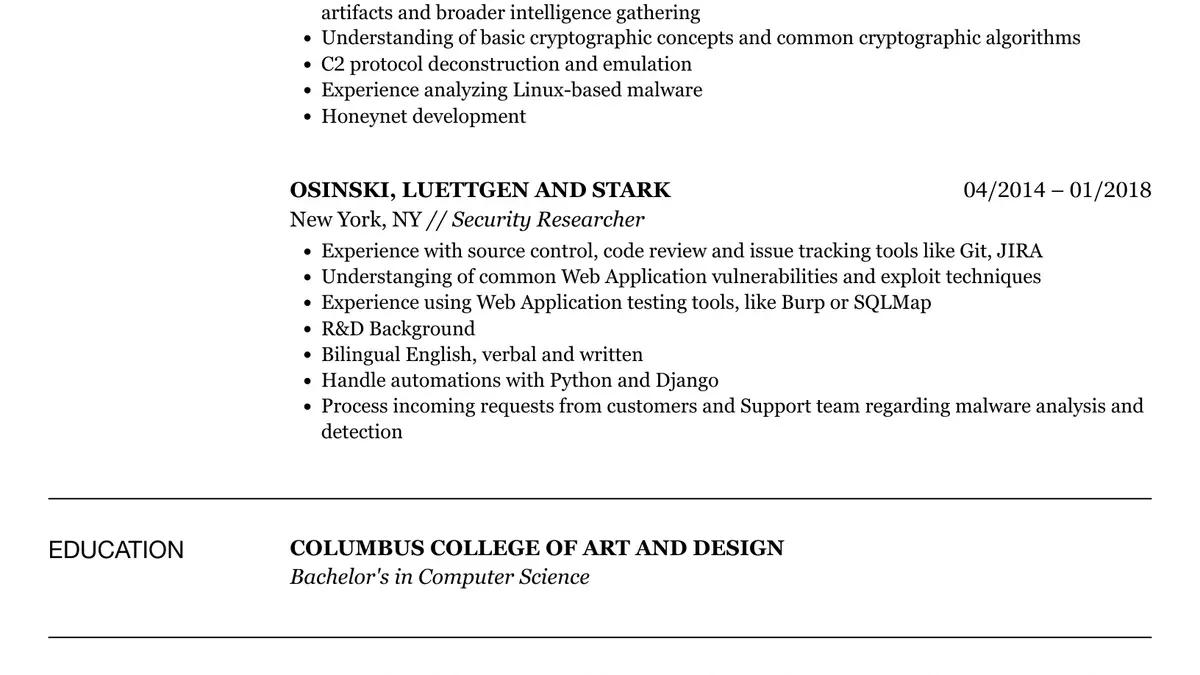
A well-optimized AI security researcher resume balances keyword integration, quantified achievements, and clear formatting to pass AI screening and engage recruiters. Below is a sample excerpt from a resume tailored for AI security roles, with annotations explaining its effectiveness.
| Resume Segment | Explanation |
|---|---|
| Professional Experience AI Security Researcher, CyberTech Solutions • Developed and deployed machine learning models to detect and mitigate adversarial attacks, improving threat detection accuracy by 30%. • Conducted vulnerability assessments on AI algorithms, reducing false positives in security alerts by 25%. • Collaborated with cross-functional teams to design secure AI frameworks compliant with industry standards (NIST, ISO 27001). | This section includes targeted keywords such as "machine learning models," "adversarial attacks," and "vulnerability assessments" that AI screening tools prioritize. Quantified achievements (30% accuracy improvement, 25% false positive reduction) demonstrate impact, which appeals to both AI and human reviewers. |
| Technical Skills • Programming: Python, TensorFlow, PyTorch • Security Tools: Metasploit, Wireshark, Nessus • AI Security Concepts: Adversarial Machine Learning, Secure Model Deployment, Threat Intelligence | Listing specific tools and concepts aligned with AI security roles helps keyword matching. Clear bullet points improve machine readability, ensuring parsing accuracy. |
| Certifications • Certified Information Systems Security Professional (CISSP) • Offensive Security Certified Professional (OSCP) • Certified Ethical Hacker (CEH) | Including recognized certifications relevant to security and ethical hacking reinforces credibility and matches common job requirements, enhancing ATS ranking. |
Formatting choices such as bullet points, clear section headers, and concise descriptions improve the resume’s readability for AI parsing algorithms. The example also aligns content closely with typical AI security researcher job descriptions by emphasizing both technical expertise and measurable outcomes.
Tip: Use consistent section titles and avoid complex formatting like tables or images in the actual submitted resume to ensure ATS compatibility, though tables are shown here for clarity in presentation.
Further reading
- Key AI Security Researcher Interview Questions and How to Answer Them
- Vulnerability Analyst Interview Questions: What to Expect and How to Prepare
Frequently asked questions
How to detect ai in resume?
Detecting AI-generated content in a resume involves looking for overly generic language, repetitive phrases, or inconsistencies in style and tone. Some employers use specialized software that flags patterns typical of AI writing, such as unnatural sentence structures or lack of personal anecdotes. Reviewing resumes for specific, verifiable achievements and tailored details also helps identify human-crafted content.
Do jobs check resumes for ai?
Many employers and recruiters use tools that can detect AI-generated resumes to maintain authenticity in candidate evaluations. These checks are part of broader efforts to ensure the resume reflects genuine experience and skills rather than machine-generated text. However, the extent of AI content screening varies widely depending on the organization and role.
Do jobs run your resume through ai?
Yes, it is common for employers to run resumes through AI-powered applicant tracking systems (ATS) that scan for keywords, qualifications, and formatting before human review. These systems assess how well a resume matches the job description and may rank candidates accordingly. This screening helps manage large volumes of applications efficiently.
Do resume through ai?
Resumes are often processed through AI-based software designed to evaluate candidate fit based on keyword matching, skill relevance, and experience. This automated review helps recruiters filter out resumes that do not meet predefined criteria. Candidates benefit from understanding how these systems operate to optimize their resume content.
Are resumes checked for ai?
Resumes may be checked for AI-generated content to verify authenticity and ensure candidates present their own qualifications. Some companies use AI detection tools as part of their hiring protocols to avoid potential misrepresentation. This verification step is increasingly relevant as AI writing tools become more accessible.
Limits of this advice and who should consider alternative approaches
This advice focuses on optimizing resumes for AI screening and does not guarantee interview invitations, as human recruiter preferences and other factors also heavily influence hiring decisions. Candidates with less conventional backgrounds or non-traditional experiences might find strict keyword optimization less beneficial and should balance AI considerations with personal storytelling and networking strategies.
The single most useful next step is to carefully tailor the resume for each specific AI security researcher job application by analyzing the job description for relevant keywords, skills, and technologies, then integrating those strategically while maintaining clarity and authenticity. This targeted customization improves the chances of passing both AI-driven screening and human review.