Key AI Security Researcher Interview Questions and How to Answer Them
Explore key AI security researcher interview questions and learn how to prepare effective answers to excel in your interview.

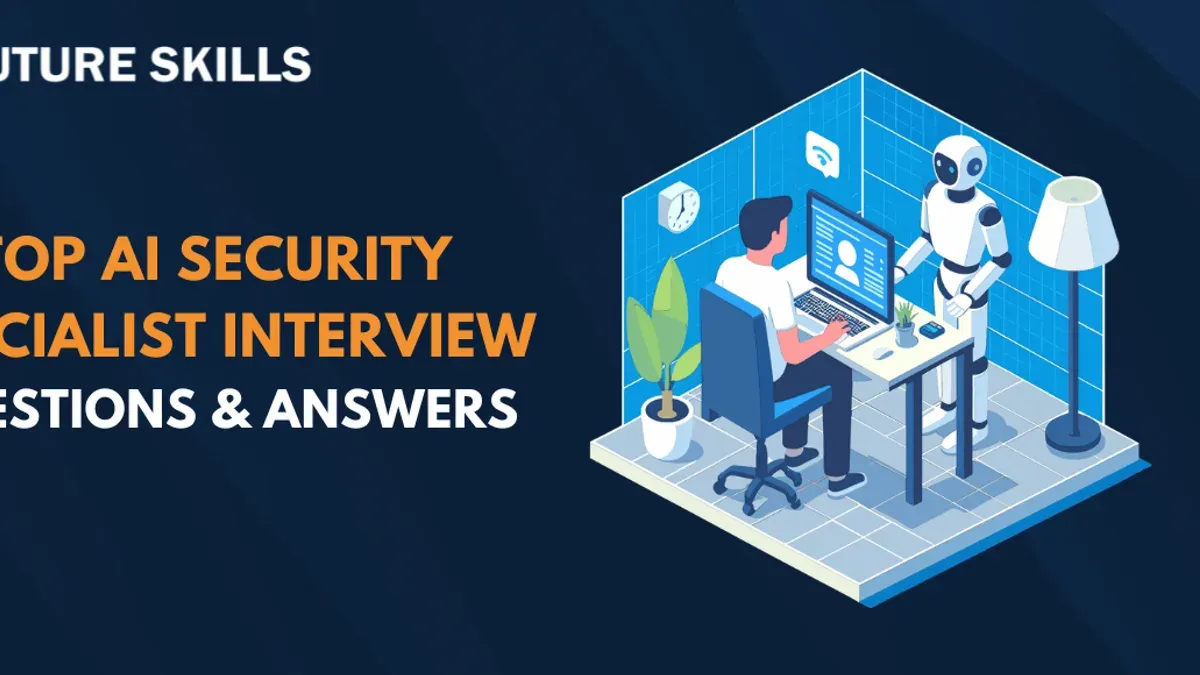
This article provides a detailed guide on AI security researcher interview questions, focusing on what candidates can expect and how to prepare effective answers.
AI security researcher interview questions often assess a candidate's expertise in both artificial intelligence principles and cybersecurity challenges. Interviews typically explore understanding of adversarial machine learning, threat modeling, vulnerability assessment, and secure algorithm design. Candidates are expected to demonstrate not only technical knowledge but also strategic thinking tailored to the unique risks in AI systems.
Preparing for these interviews requires familiarity with specific attack vectors on AI models, defensive techniques, and the ability to articulate problem-solving approaches clearly. This guide aims to help aspiring and current researchers navigate the nuances of AI security roles by combining question examples with insight into interviewers’ expectations.
What AI security researcher interview questions test
Interview questions for AI security researcher roles assess a candidate’s expertise across several key domains. Core competencies include a deep understanding of AI algorithms and the security challenges unique to machine learning systems. For example, candidates might be asked to explain how adversarial attacks manipulate model inputs and to discuss potential defense mechanisms such as adversarial training or input sanitization.
Knowledge of data privacy and ethical considerations is frequently evaluated, reflecting the increasing importance of responsible AI deployment. Familiarity with security frameworks and compliance standards, such as NIST or GDPR, is often tested to ensure candidates can navigate regulatory environments influencing AI systems.
Problem-solving skills and research methodology are critical, as roles demand not only identifying vulnerabilities but also designing novel solutions. Job descriptions commonly highlight these areas, specifying requirements like experience with threat modeling, penetration testing of AI components, and publishing security research.
For instance, a typical interview question may present a scenario involving a poisoned dataset affecting model integrity, requiring the candidate to outline detection strategies and remediation steps. This tests both technical knowledge and applied problem-solving under realistic conditions.
Common AI security researcher interview questions and model answers
One typical question asks to explain adversarial machine learning and common attack vectors. A strong answer defines adversarial machine learning as techniques that manipulate input data to fool AI models, such as evasion attacks where inputs are subtly altered to cause misclassification. Interviewers look for awareness of attacks like poisoning, where training data is corrupted, and model inversion attacks that extract sensitive information.
When asked how to secure AI models in production, a good response outlines methods like implementing robust input validation, using adversarial training to improve resilience, monitoring model behavior for anomalies, and employing encryption for model parameters. Detailing a pipeline with continuous security audits and access controls shows practical understanding.
Discussing trade-offs between model accuracy and security, a candidate should explain that increasing robustness may lower accuracy due to conservative decision boundaries. Citing a concrete example, such as using adversarially trained models that reduce error rates on clean data but increase computational costs, demonstrates insight.
For conducting a security audit on an AI system, a stepwise approach includes reviewing data sources for integrity, testing for adversarial vulnerabilities, verifying compliance with privacy regulations, and assessing deployment environments for risks. Interviewers expect mention of both technical and procedural checks.
Handling bias and fairness involves identifying biased training data, applying techniques like reweighting or data augmentation, and validating model outputs across demographic groups. A thorough answer discusses the importance of transparency and continuous monitoring to ensure equitable AI behavior.
How AI security researchers demonstrate problem-solving during interviews
AI security researcher candidates often demonstrate problem-solving by walking through a security challenge or case study provided by interviewers. For example, a prompt might describe a scenario where an AI model is vulnerable to adversarial inputs designed to manipulate its output. Candidates are expected to outline a systematic approach, such as identifying attack vectors, designing detection mechanisms, and proposing mitigation strategies while considering trade-offs between robustness and model performance.
Discussion of past research projects is another key method. Candidates describe specific studies where they addressed security vulnerabilities in AI systems, explaining methodologies, results, and lessons learned. This not only shows technical depth but also an ability to communicate complex work effectively.
Technical exercises like coding or simulation tasks further validate understanding. For instance, candidates may be asked to implement a simple adversarial attack or defense algorithm in a controlled environment, demonstrating both coding proficiency and theoretical knowledge.
Tip: Clear and concise communication is essential; candidates should explain complex concepts in accessible terms without oversimplifying, ensuring interviewers grasp their reasoning and problem-solving approach.
AI intern interview questions in security research roles
Internship interviews for AI security research roles focus on assessing foundational knowledge and practical skills suitable for early-career candidates. Expect questions that probe understanding of basic AI concepts like supervised learning, neural networks, and simple algorithms, alongside fundamental security principles such as authentication, encryption, and common vulnerabilities.
Typical tasks include straightforward problem-solving scenarios and coding exercises, often involving Python or similar languages. For example, a candidate might be asked to write a function that detects adversarial perturbations on a small dataset or explain how to secure a data pipeline from injection attacks.
Interviewers also gauge motivation and interest in AI security research through questions like, "What ethical challenges do you think AI security raises?" or "Why pursue a career in AI security research?" Candidates should demonstrate awareness of ethical concerns such as bias, privacy, and responsible AI deployment.
Example question: "Describe how you would approach detecting adversarial inputs in a simple image classification model." A good response outlines basic signal detection strategies, mentions trade-offs between false positives and negatives, and indicates familiarity with adversarial examples without requiring deep technical detail.
Common mistakes to avoid in AI security researcher interviews
One frequent pitfall is overlooking the ethical implications of AI security decisions. Candidates who focus solely on technical solutions without addressing potential misuse or bias often leave interviewers concerned about their holistic understanding of AI risks. For example, proposing a defensive measure that compromises user privacy without acknowledging the trade-off can signal a narrow perspective.
Another common error is failing to communicate clearly. Using excessive jargon without explanation or speaking in overly technical terms can confuse interviewers, especially those from interdisciplinary teams. Clear, accessible answers demonstrate not only knowledge but the ability to collaborate effectively.
Neglecting to highlight practical experience or the real-world impact of research can also weaken a candidate’s impression. Interview feedback shows that candidates who only discuss theoretical concepts miss opportunities to showcase how their work has addressed tangible security challenges or influenced AI safety practices.
Finally, ignoring questions about trade-offs or limitations undermines credibility. Interviewers expect candidates to recognize that every security solution involves compromises, such as balancing robustness against computational cost. Candidates who do not acknowledge these nuances appear less prepared for complex, real-world problems.
Further reading
- Vulnerability Analyst Interview Questions: What to Expect and How to Prepare
- Vulnerability Analyst Resume Example and Career Guide
- How to Scan a Website for Malware: A Clear Step-by-Step Guide
- How to Stop Brute Force Login Attacks on WordPress: A Step-by-Step Guide
Frequently asked questions
What are some AI interview questions and answers for security researcher roles?
Interview questions often focus on threat modeling for AI systems, adversarial machine learning techniques, and secure data handling methods. Candidates may be asked to explain how to detect and mitigate data poisoning or evasion attacks. Providing clear examples of past work or hypothetical scenarios demonstrating defense mechanisms is advantageous.
How do AI job interview questions differ for research scientists?
Research scientist interviews emphasize theoretical understanding, algorithm development, and experimental design rather than direct security applications. Questions often probe knowledge of machine learning fundamentals, innovation potential, and publication experience. Security-specific roles add layers of questions about system vulnerabilities and threat analysis.
What AI testing interview questions should candidates expect?
Testing questions typically explore validation methods for AI models, robustness checks, and evaluation metrics under adversarial conditions. Candidates might be asked how to design tests that identify bias, overfitting, or susceptibility to attacks. Clear articulation of systematic testing strategies and trade-offs is expected.
What topics are covered in AI related interview questions for security?
Topics commonly include adversarial attacks, secure model training, privacy-preserving machine learning, and anomaly detection. Interviewers may assess knowledge of cryptographic methods applied to AI, trustworthiness of AI outputs, and compliance with security standards. Familiarity with recent research trends and practical defenses is often tested.
What this advice does not cover and who should look elsewhere
This guide focuses on interview preparation for AI security research roles and does not cover other AI career paths such as AI engineering or data science in depth. Professionals targeting roles outside AI security research may find different question types and evaluation criteria more relevant to their objectives.
Answers and advice provided may not apply to all companies or interview formats, especially those with unique or proprietary evaluation methods. Candidates interviewing with organizations known for unconventional or highly specialized hiring processes should seek tailored preparation resources aligned with those formats.
The single most useful next step for aspiring AI security researchers is to engage in mock interviews centered on AI security scenarios, emphasizing clear communication of technical concepts and problem-solving approaches. This practical experience helps internalize the interview dynamics and reveals areas needing further refinement.