Best Certifications for Security Data Scientists in 2026: Ranked and Reviewed
Explore top certifications that blend cybersecurity and data science skills, ranked and reviewed to help security data scientists excel in 2026.

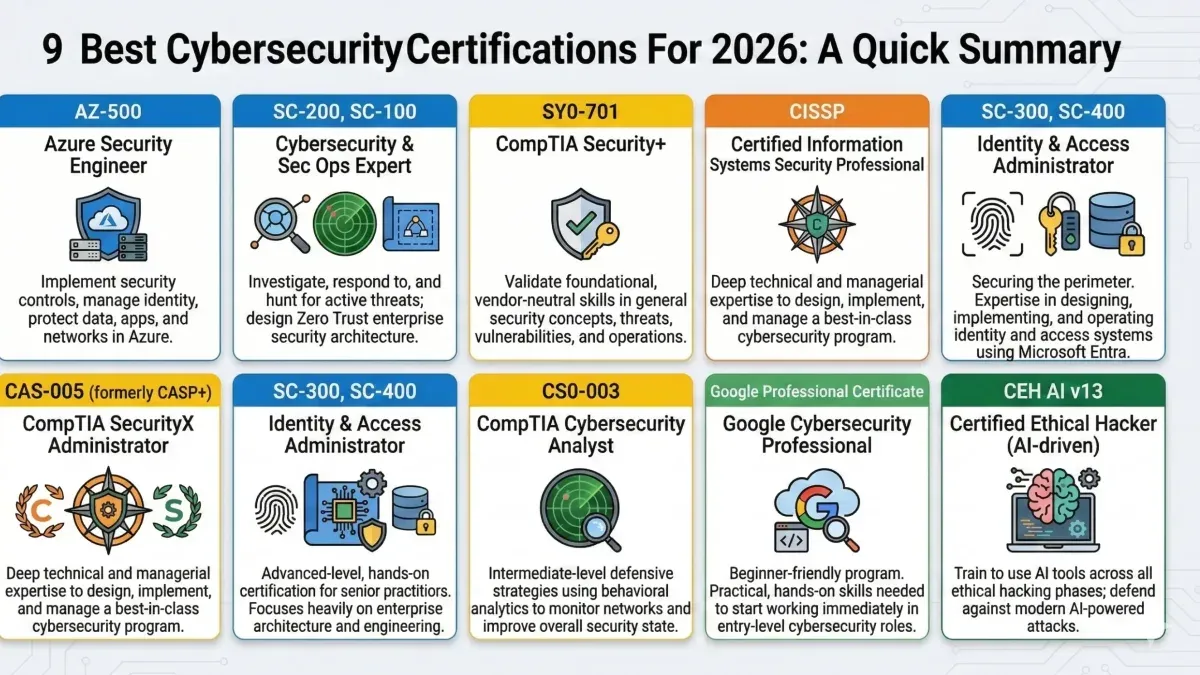
Choosing the best certifications for security data scientist roles requires a nuanced understanding of both cybersecurity and data science disciplines. This article ranks and reviews top certifications that blend these skill sets, helping professionals identify credentials that align with their career objectives and technical gaps. The hybrid nature of security data science demands certifications covering broad security principles, hands-on attack techniques, data privacy laws, and advanced analytics.
Each certification is evaluated on relevance, depth, and industry recognition, offering a balanced perspective for candidates seeking to specialize in this evolving field. From foundational security credentials to specialized data science certificates, this guide highlights options that provide practical knowledge and strategic value in 2026.
How we chose the certifications for security data scientists
Certifications selected for this ranking address the dual demands of cybersecurity and data science, ensuring candidates gain competence in both security fundamentals and advanced machine learning techniques. These credentials are recognized by industry employers, frequently cited in job postings for security data scientist roles, and updated regularly to reflect 2026’s evolving security threats and data handling practices.
Our methodology involved reviewing the latest certification syllabuses to confirm they incorporate recent developments such as adversarial machine learning and cloud-native security analytics. We also surveyed hiring managers and practitioners within security data science teams to understand which credentials they prioritize and why. This feedback highlighted the importance of a balance between technical depth, practical application, and accessibility for professionals at different career stages.
Each certification’s evaluation includes a clear description of its target audience, a concrete strength such as industry recognition or specialized content, and a candid drawback like limited applicability or steep learning curves. This approach aims to help candidates make informed decisions tailored to their unique skill gaps and career objectives.
Certified Information Systems Security Professional (CISSP): The broad security foundation
What it is: CISSP is a globally recognized advanced security certification managed by (ISC)². It covers eight domains, including Security and Risk Management, Asset Security, Security Engineering, Communication and Network Security, Identity and Access Management, Security Assessment and Testing, Security Operations, and Software Development Security. This wide-ranging scope ensures a comprehensive understanding of security principles essential for protecting organizational assets.
Who it suits: CISSP is ideal for experienced professionals who want a robust security foundation to complement their data science expertise. Candidates typically need at least five years of cumulative paid work experience in at least two of the eight domains, emphasizing a broad security background rather than data science specialization.
Strength: With its extensive domain coverage, CISSP equips security data scientists with a strong grasp of risk management and security operations, which are critical for designing effective data protections and interpreting security-relevant data.
Drawback: The certification’s broad focus means it lacks specialized content tailored to data science, and the five-year experience requirement can be a barrier for professionals transitioning from pure data science roles.
Evidence: Many security data scientists hold CISSP due to its industry recognition and comprehensive curriculum, aligning well with job descriptions that demand deep security knowledge alongside analytical skills. However, the certification’s generalist approach means candidates often complement it with data science–specific credentials.
Certified Information Security Manager (CISM): For security governance and data risk management
The Certified Information Security Manager (CISM) certification emphasizes security management, governance, and risk management, targeting professionals who oversee an organization's information security program. It is particularly relevant for security data scientists responsible for aligning data analytics with business objectives and ensuring compliance with security policies.
This certification suits security data scientists involved in policy development, compliance monitoring, and strategic oversight of data-related security risks. Typical roles include security managers within analytics teams or data governance leads who bridge the gap between technical teams and executive management.
A key strength of CISM is its focus on managing security risks and governance frameworks, which equips candidates to influence organizational strategy and compliance in data-driven environments. However, its managerial and policy-oriented approach means it offers less technical depth and fewer hands-on skills with data science tools, which can limit its appeal for those seeking to enhance technical expertise.
Organizations increasingly value CISM for roles requiring security leadership in analytics, with surveys indicating it supports career progression into managerial positions. Security analytics teams aiming to integrate risk management and governance with data science often consider CISM a valuable credential to complement technical certifications.
Certified Ethical Hacker (CEH): Hands-on attack perspective for data scientists
The Certified Ethical Hacker (CEH) certification focuses on penetration testing and ethical hacking techniques, providing a practical understanding of how attackers operate. It covers reconnaissance, scanning, exploitation, and post-exploitation methods, enabling security data scientists to anticipate attack vectors and improve threat detection models.
CEH suits data scientists who seek direct insights into attacker tactics to enhance the development of data-driven detection strategies. By grasping the attacker’s mindset, CEH-certified professionals can tailor algorithms to detect subtle indicators of compromise more effectively.
A notable strength of CEH is its practical, hands-on approach to cybersecurity challenges, which complements theoretical knowledge with real-world attack simulations. For example, data scientists with CEH have been documented in case studies to refine anomaly detection by incorporating attacker behavior patterns learned during certification training.
The main drawback is CEH’s limited focus on advanced data analytics tools and statistical methods, which means it does not directly address the data science techniques crucial for sophisticated model building. Candidates must supplement CEH with dedicated data science certifications to cover analytical rigor fully.
GIAC Security Data Scientist (GSDS): The specialized credential for security data science
What it is: The GIAC Security Data Scientist (GSDS) certification is unique in its focus on applying data science techniques directly to cybersecurity challenges. It covers topics including statistical analysis, machine learning, threat intelligence, anomaly detection, and security data visualization, combined with cybersecurity fundamentals. The exam syllabus is divided roughly between core data science methods and their security applications, testing practical skills such as using Python for security analytics and interpreting security datasets.
Who it suits: GSDS is tailored for professionals who already have intermediate data science skills and want to specialize in security analytics. Candidates typically have experience in data analysis or cybersecurity and seek a credential that bridges both domains, making it ideal for security data scientists looking to deepen their technical expertise in analytics-driven security roles.
One concrete strength: GSDS is the only certification explicitly designed for the hybrid role of security data scientist, providing targeted training and validation of skills that are highly relevant to this niche. Employers in sectors relying on advanced security analytics recognize it as evidence of specialized capability.
One honest drawback: As a relatively new certification, GSDS is not yet as widely recognized as CISSP or CEH. It also requires a strong foundation in data science, which can be a barrier for cybersecurity professionals without that background. This limits its accessibility and immediate value for those starting from a pure security or entry-level data science position.
Evidence: Employer surveys indicate growing but still limited recognition compared to more established security certifications. Testimonials from GSDS holders highlight improved job prospects in roles focused on threat detection and security analytics, though some note the challenge of meeting the prerequisite data science skills.
Microsoft Certified: Azure Security Engineer Associate + Data Scientist Associate: Cloud and analytics synergy
The Azure Security Engineer Associate certification targets professionals who implement security controls, maintain the security posture, and manage identity and access in Azure environments. It suits security data scientists working directly with cloud-native security tools and infrastructure. A key strength is its focus on practical security tasks within Azure, including configuring security policies and threat protection. However, it requires deep familiarity with Azure services and security features, which can be a steep learning curve for those outside the Microsoft ecosystem.
The Azure Data Scientist Associate certification focuses on designing and implementing data science solutions on Azure using services like Azure Machine Learning. It is ideal for security data scientists leveraging cloud analytics to detect and respond to threats. This certification emphasizes applying machine learning models to real-world data securely within Azure. Its drawback is that it covers only the data science aspects and assumes foundational knowledge of cloud architecture.
Combining these two role-based certifications addresses the hybrid demands of security data scientists in cloud environments. Job market trends in 2026 show growing demand for professionals who can secure cloud infrastructure and simultaneously apply advanced analytics to security data. Candidates should note this path requires commitment to Microsoft’s ecosystem and multiple exams to cover both security engineering and data science expertise.
Certified Information Privacy Professional (CIPP): Navigating data privacy regulations
The Certified Information Privacy Professional (CIPP) certification centers on global privacy laws and data protection regulations such as GDPR, CCPA, and HIPAA. It equips security data scientists with a clear understanding of legal frameworks that govern the handling of personal and sensitive information.
This certification suits security data scientists working in regulated sectors like healthcare, finance, or telecommunications, where compliance with privacy mandates is critical. Professionals involved in personal data analytics benefit from CIPP by aligning their projects with evolving privacy requirements.
A key strength of the CIPP is its focus on compliance knowledge, enabling security data scientists to design data processes that minimize legal risks and support organizational privacy policies. Employers increasingly prefer candidates with CIPP for roles that demand strict adherence to data privacy regulations and audit readiness.
However, CIPP is not a technical security certification. It lacks focus on cybersecurity controls or data science methodologies, making it less suitable for those seeking hands-on technical skills. Instead, it complements technical certifications by addressing the legal and compliance dimensions of security data science.
Certified Analytics Professional (CAP): Strengthening analytical rigor
The Certified Analytics Professional (CAP) is a vendor-neutral certification that validates mastery of the end-to-end analytics process, including framing business problems, data methodology, model building, and deployment. It is designed to certify the analytical rigor of professionals across industries rather than focus on specific security challenges.
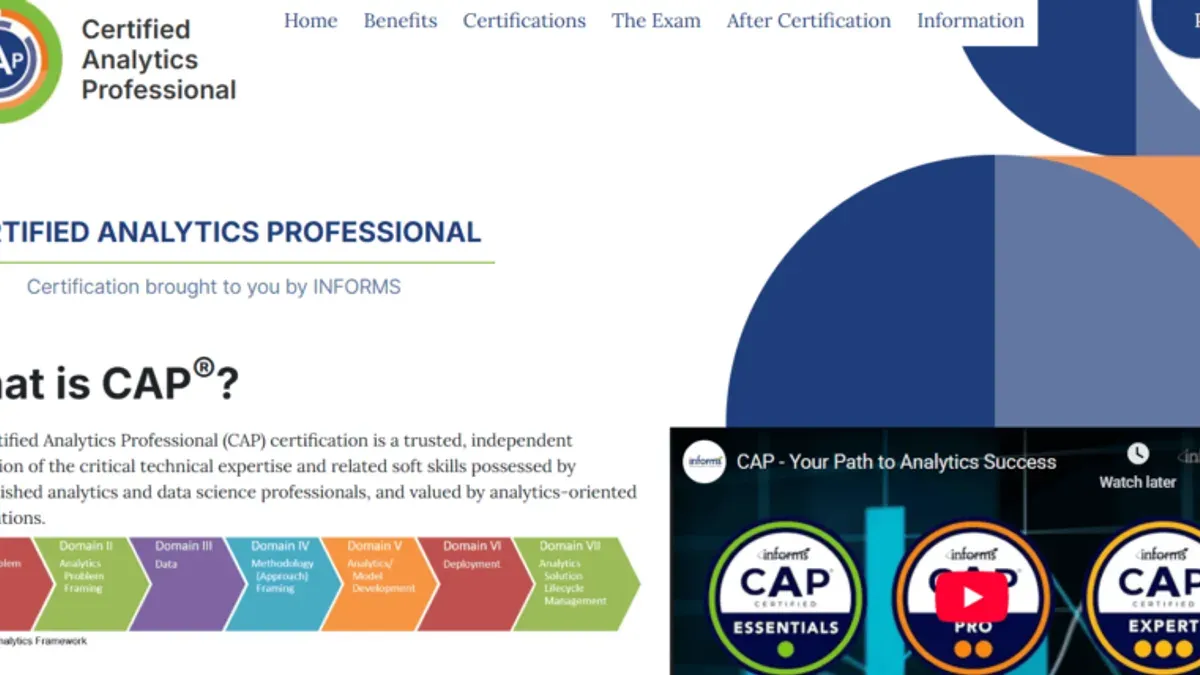
Security data scientists seeking to demonstrate credible and comprehensive analytics expertise beyond the security domain find CAP valuable. It signals to employers a solid foundation in analytics principles, complementing security-oriented certifications. However, CAP does not cover security-specific content, so it is best paired with a dedicated security certification for a balanced skill set.
Comparatively, CAP offers broader analytics depth than the GIAC Security Data Scientist (GSDS) certification, which integrates analytics with security concepts but is newer and less widely recognized. Professionals holding CAP have been observed in security analytics roles where strong analytics rigor supports threat modeling and anomaly detection, though CAP alone may not suffice for specialized security knowledge.
Tip: Pair the CAP with a security credential to showcase both robust analytics skills and cybersecurity expertise.
Certifications to avoid or be cautious about for security data scientists
Some certifications, while popular in their domains, fall short for security data scientists due to their limited relevance to the hybrid skills required in 2026.
Pure data science certificates without security context
Examples include generic data science bootcamps or certificates focused solely on machine learning or statistics. These programs suit professionals seeking foundational data science skills and often offer strong analytical techniques and programming exposure. However, they lack any cybersecurity focus or threat awareness, which hiring managers note as a critical gap for security data scientist roles. Job postings rarely list such certificates as requirements or preferred qualifications.
Security certifications with no data science or analytics relevance
Certifications like Cisco CCNA Security are designed for network security engineers and administrators. Their strength lies in network infrastructure protection and hands-on device configuration. Yet, these credentials provide no training in data analytics, machine learning, or data-driven threat detection, making them of limited value for security data scientists. Industry feedback highlights that these certifications do not prepare candidates for the analytical and data-centric aspects of the role.
Outdated or lacking current 2026 relevance
Some older security certifications no longer reflect the current threat landscape or evolving data science methodologies. While they may have been valuable historically, their curricula often omit cloud security, big data, or advanced analytics topics now essential in 2026. Hiring managers frequently overlook these outdated credentials in favor of certifications that align with emerging technologies and integrated security-data science skill sets.
Tip: Candidates should carefully review certification content and industry demand to avoid investing time and resources in credentials that do not directly support the security data scientist role.
Further reading
- Best Certifications for Security Awareness Managers in 2026
- Best Certifications for Detection Engineers in 2026
- Best Certifications for Cyber Threat Hunters in 2026
- Best Certifications for Cryptographer in 2026: Expert Guide to Career and Skills
Frequently asked questions
What certifications best combine cybersecurity and data science skills?
The GIAC Security Data Scientist (GSDS) certification is designed specifically to merge cybersecurity and data science expertise. Additionally, pairing certifications like Certified Ethical Hacker (CEH) with data science-focused credentials such as the Microsoft Certified: Data Scientist Associate can provide a balanced skill set. These options give candidates both the technical depth in data analytics and the security knowledge needed for the hybrid role.
Are there entry-level certifications for aspiring security data scientists?
Entry-level certifications such as CompTIA Security+ and Microsoft Certified: Azure Fundamentals provide foundational cybersecurity and cloud knowledge. For data science basics, certifications like Microsoft Certified: Data Analyst Associate offer a starting point. While these are not specialized security data scientist credentials, they build the essential skills required before advancing to more focused certifications.
How important is hands-on experience compared to certifications in this field?
Hands-on experience is critical for security data scientists, as practical skills in data analysis, threat detection, and incident response complement theoretical knowledge. Certifications validate understanding but do not replace the ability to apply techniques in real-world scenarios. Employers typically value candidates who demonstrate both certified knowledge and relevant project or work experience.
Can certifications replace formal education for security data scientists?
Certifications can enhance and validate specific skills but generally do not substitute for a formal education in computer science, cybersecurity, or data science. Formal degrees provide foundational theory and broader context that certifications may not cover. However, for professionals with relevant degrees, certifications can be an effective way to specialize and keep skills current.
Limitations of This Certification Guide
This article focuses on certifications relevant as of 2026 and may not cover emerging credentials developed after this date. Professionals seeking to specialize in cutting-edge or niche security data science areas should explore the latest industry updates and new certifications as they become available.
Certifications alone do not guarantee job placement; practical experience, continual learning, and hands-on skills remain essential to success in the hybrid security data scientist role. Candidates should balance certification pursuit with real-world projects and ongoing education.
Some certifications require substantial prior experience, which may limit accessibility for newcomers or those transitioning from unrelated fields. Early-career professionals may need to start with foundational certifications or technical training before advancing to highly specialized credentials.
The Most Useful Next Step
Identifying specific skill gaps based on current job requirements and career goals is the most effective next step. Candidates should assess their knowledge in key areas such as cybersecurity fundamentals, data analytics, and regulatory compliance, then prioritize certifications that directly address those gaps to maximize both learning and career impact.